Showing posts with label World Cinema. Show all posts

Tuesday, September 8, 2020

Stachka (Strike)

Image credit: Amazon.co.uk
In a depressing start to a gloomy Wednesday morning, I just finished watching a silent masterpiece that brutally highlights the despicable and unfeeling side of humanity. Sergei Eisenstein’s Stachka (or Strike) might be a bit dated, but it really hammers home the idea that humans as a species have a diabolical dark side that tends to win out every time, especially in times of high stress. 

Strike depicts an uprising in a Russian factory, as a series of mistreatments mixed with the authorities’ greed and dishonesty goad the workers towards rebellion. Told in six parts, the film begins with a series of ripples, which then grow into the dramatic events of the following chapters, escalating to strike, starvation, counter rebellion, and finally a massacre. 

Intended to mark the beginning of a series of works about the rise of Marxist-Lenin rule, Strike never got its follow-ups thanks to Bolshevik censorship. However, the film does work as a stand-alone feature (indeed it was Eisenstein’s first and paved the way for other such masterpieces as The Battleship Potempkin [1925] and October [1927]). 

 Eisenstein explores various cinematic tricks and motifs that greatly exacerbate the central drama and carnage of the political messages, the most poignant being in the final chapter where depictions of the massacre are intercut with scenes of cows being slain in a slaughterhouse. This graphically horrific and metaphoric trick is enough to break one’s positive spirit and cause nightmares, even a seasoned mover-goer. 

Image credit: Silver in a Haystack

But of course, this is the point. Eisenstein’s fascination and appreciation of the film medium as a communication, cultural and political means of expression really comes across with this film and while his treatment of his audience is to emotionally hijack them and then continuously punch them in the face until their nose cave and their cheekbones splinter, it nevertheless gets the job done effectively. 

Director: Sergei M. Eisenstein, 1924 Cast: Grigori Aleksandrov, Aleksandr Antonov, Yudif Glizer, Mikhail Gomorov, I. Ivanov, Ivan Klyukvin, Anatoll Kuznetsov, Vladimir Uralsky, Vera Yanukova, & Boris Yurtsev

Tuesday, August 27, 2019

The Myth

Image credit: Bluray.com
One of the many things that I love about cinema is its universality and the fact that popular traits and trends can cross the globe and settle in another country’s movies. Sometimes this migration works very well… and then sometimes it doesn’t, like last night’s pick: The Myth.

The film tells the story of archaeologist Jack (Jackie Chan) who is troubled by vivid recurring dreams in which he is an ancient general sworn to protect a princess named Ok-Soo. Despite recording his dreams in a journal, Jack is not driven to find answers to these dreams until an expedition with a scientist friend of his goes awry and he discovers there might be such a thing as past lives.

Made in 2005, The Myth is a classic example of Chinese cinema taking multiple leaves out of Western blockbusters’ books, trying to copy what’s popular. While there is absolutely nothing wrong with this, in this movie it doesn’t seem to have been done with any real understanding or sense of pace and, as a result, the movie suffers from this jagged plot pace that just doesn’t work.

Image credit: Conventionpan
The story itself is fine, though certain aspects of it are somewhat questionable, irritating, and/or pointless, with the film beginning as one story and then somehow developing a secondary plotline midway though (which I’m still slightly confused about). Mediocre characters and martial arts sequences populate the scenes, predictably but seamlessly transitioning from the present to the past in what can only be described as a cringing, wannabe epic fantasy puddle.

Despite its obvious flaws, there is a slightly humorous undertone to the film when we consider that Chan’s character chastises tomb raiders and people who deprive natural museums of their own cultural artefacts in a film that borrows pretty heavily from Western culture and doesn’t really have a feel of cultural authenticity. At the end of it all, I have to say that I was confused by this movie rather than entertained.

Director: Stanley Tong, 2005

Cast: Jackie Chan, Bing Shao, Weixing Yao, Hee-seon Kim, Min-Su Choi, Tony Ka Fai Leung, Maggie Lau, Leon Head, and Zhou Sun

Monday, June 17, 2019

The Raid: Redemption

Image credit: IMDb
One of the many things that I love about cinema is its various genres and the appreciation of the audiences of those genres. When you’re watching with the right person, a film that you might never consider to be your taste and would not sit down to watch on your own steam can magically become something that you really appreciate. Cinematic appreciation is infectious and that is one of the many ways in which movies bring people together. This afternoon my partner and I curled up on the couch for a romantic bout of violence and action with The Raid.

The film tells the story of an elite SWAT team that is assigned the job of infiltrating an impregnable drug fortress and taking out the leader. But the team gets more than they bargained for when the raid goes wrong and the leader and his minions, which happens to be the majority of the residents of the apartment block that is the fortress, are alerted to their presence. After an early massacre, the SWAT team sergeant, a corrupt lieutenant, a rookie cop, and an invalid are all that remain of the force stranded on the sixth floor, and soon a bloody nightmare becomes real as they work to fight their way out.

While it doesn’t seem like an awful lot on the surface, there’s a lot happening in The Raid that makes it a most interesting film. Despite being far removed from kung-fu action movies, there is certainly something of that style of film within the folds of The Raid, with the central characters and much of the main fights and conflict happening without the aid of machine guns, but pencak silat, an Indonesian style of martial arts that is influenced by Indian and Chinese martial arts. Reflective of its featured fighting style, one can certainly see the influences of kung fu movies in this film with the most thrilling and memorable scenes being those that feature one unarmed fighter against a whole, knife-wielding gang. The fight scenes are immaculately choreographed with the accompanying sound design being spot-on in making us feel those painful jabs and punches.

Image credit: Comic Value
The story itself is very simple and becomes pretty reminiscent of western cinema’s one-man war, as there is basically only one good guy fighting against the armed residency of an entire apartment building on lockdown. Very Die Hard, but without those great one-liners. Amidst the fighting and the violence, of which there is a fair bit, there are some lovely little complex stories about conflictions of duty and honour, along with the hero’s personal secret struggle and ulterior motives for being in this death trap.

The Raid: Redemption is a truly interesting movie, a lot like the puddle: it doesn’t look like much on the surface, but when you poke a stick into it, you discovers there’s more to it than that.

Director: Gareth Evans, 2011

Cast: Iko Uwais, Joe Taslim, Donny Alamsyah, Yayan Ruhian, Pierre Gruno, Ray Sahetapy, Tegar Satrya, Iang Darmawan, Eka Rahmadia, and Verdi Soliman

Sunday, May 5, 2019

La Souriante Madame Beudet (The Smiling Madame Beudet)

Image credit: Wikipedia
While characters such as Captain Marvel and Wonder Woman might be outshining the menfolk in the cinema today, the whole ‘sisters are doing it for themselves’ thing is nothing new. Indeed one of the earliest celebrated works of feminist cinema and slams against the patriarchy goes back as far as 1922, with Germaine Dulac’s La Souriante Madame Beudet (The Smiling Madame Beudet).

The film tells the story of a despondent and unfulfilled provincial housewife (Germaine Dermoz) whose only escape from her monotonous existence is daydreaming. Her husband, a man with a warped sense of humour is constantly playing a prank on her in which he holds an unloaded revolver to his head and threatens to shoot. When her husband begins to intrude upon her daydreams, she decides to take the fun away from his joke by putting bullets in the gun.

The Smiling Madame Beudet proves to be an important piece in movie history for a number of reasons. First, it is one of the earliest recorded works of feminist cinema. The film is an exploration into patriarchal oppression both culturally and within the home. This is highlighted by the heroine’s lack of control in all of her daily ventures, including the straightening of the house. One particularly poignant scene, which is both humorous and heartbreaking, is the constant battle of the flower vase in which Madame Beudet will move it elegantly to the side of the table, only to have Monsieur Beudet shift it back to the centre. A simple, but powerful metaphor for the amount of control exercised by the patriarchy, it is these delicate motifs and scenes that give the film its power.

Image credit: YouTube
Alongside being one of the earliest examples of feminist cinema, the film is also celebrated as a work of experimental cinema, with Madame Beudet’s daydream sequences using an array of clever photographic tricks and filmic twists to convey the fantasy of the scenes as well as the drama, hostility, and melancholy behind them.

The film’s short duration mixed with the uncanny amount of suspense it manages to build within that time –which my or may not find satisfactory release- makes The Smiling Madame Beudet a most moving piece of cinema, even if it does leave one feeling a tad dispirited at the end.

Director: Germaine Dulac, 1922

Cast: Germaine Dermoz, Alexandre Arquilliere, Jean d’Yd, and Madeleine Guitty

Saturday, September 15, 2018

Kung Fu Yoga

Image credit: IMDb
Ever find a film that is trying so to be something popular and being so sincere about it that you cannot help but laugh at it? That was me last weekend when I curled up with my partner and we decided to check out Kung Fu Yoga.

It follows the story of an archaeologist (Jackie Chan) who embarks on a dangerous mission to some Tibetan ice caves to find the remains of an ancient group of warriors and unlock the mysteries of a hidden treasure in India.

While there are certain aspects of this movie that have that campy, spoofy, satirical vibe of Kung Fu Hustle or The Mermaid, for the most part Kung Fu Yoga is a Chinese movie that takes all the popular bits from Western ‘classics’ and smooshes them together. There story itself is very Indiana Jones to the point where the references are almost painful, then we have a little Mission Impossible, a little The Hangover, and it’s rounded off with a closing Bollywood scene. It would be funny if there wasn’t this feeling of complete sincerity throughout the movie; like it’s trying to hard to be like the popular kids and just really not pulling it off.
There is definitely more kung fu than yoga, which makes the title itself pretty redundant, and ironically there is still a pretty weighty level of Orientalism or romanticism of the exotic, namely in the form of the female characters who are Indian princesses and thus get to wear beautiful, but sexualised attire.

Image credit: India.com
The progress of the story is wholly predictable to point of making one groan and while the characters themselves are kind of cool, they are pretty clichéd and burdened with gimmicks and one-liners that fall flat due to lack of context.

It’s a bit of a blunder as a kung fu movie and if you watch it, you watch it for its silliness and predictability because, aside from reading the subtitles, there’s not a lot of brain stimulation to be had from it.

Director: Stanley Tong, 2017

Cast, Jackie Chan, Disha Patani, Amyra Dastur, Aarif Rahman, Miya Muqi, Sonu Sood, Paul Philip Clark, Yixing Zhang, Yuxian Shang, Jiang Wen, Eric Tsang, and Guoli Zhang

Sunday, April 15, 2018

The Mermaid

Image credit: Netflix Aus/NZ
I think the wonderful thing about genre is that it translates into any language. Like facial gestures, there are modes and themes that are universally recognisable and help you to enjoy –or dislike- a film even if you don’t speak the language. One such film that I spent an enchanting night in with was Stephen Chow’s The Mermaid.

An unoriginal, but still very sweet story The Mermaid tells the tale of a rich business owner (Chao Deng) destroying the marine ecosystem with his property developments and a beautiful mermaid (Jelly Lin) sent on a mission to seduce and assassinate him. After an unsuccessful murder attempt the two end up on a date and falling in love. Will she choose love over her own kind? And what will happen if he finds out what she really is?

Forbidden romance stories are as old as the hills and despite its lack of a Rastafarian crab singing about life under the sea, The Mermaid stands as a charming fantasy movie and romantic comedy. Chow’s clever mixture of genre satire and physical comedy could subdue the gag reflex on even the most gooey and clichéd love story, which proves useful here as it lulls you into such a complete state of chilling-out-with-a-popcorn-flick that you can’t even get annoyed about Chow’s misogynist treatment of his female characters.
An entire cast of women feature in this film and none are really shown in the best light. We’ve got the business-driven femme fatale who turns into a jealous bitch when the leading man’s attentions aren’t on her, there’s Shan the mermaid who plays the role of innocent and endearing cute girl that charms the lead with her naïve sincerity, and then a whole score of women that are just gold diggers. One woman we can admire is the grandmother mermaid who is not only the epitome of wisdom, but also a total badass.

Image credit: Express Elevator to Hell
The film is a mixture of sincere love story and bumbling spy comedy, as the story is rich with character transformation and enlightenment while all of the visual, laugh-out-loud moments come from the mermaids’ botched attempts at being assassins. Memorable scenes like the octopus cooking his own tentacles rather than blow his cover or Shan’s attempts to kill Xuan literally backfiring while the hapless lead dances like there’s no one watching completely make up for the film’s gender profiling and questionable special effects. For a quiet night in, it’s worth a look.

Starring: Chao Deng, Jelly Lin, Zhixiang Luo, Yuqi Zhang, Ke Xu, Zhang Wen, Yifan Wu, Shangzheng Li, Zhengyu Lu, Chi Ling Chiu, Mei-e Zhang, Rina Matsuoka, Barbie Liu, Zhen Zhen Xu, and White-Ke

Country: China

Monday, January 2, 2017

Kung Fu Hustle


Whilst not everyone may be a fan or appreciate certain types of movies like war or kung fu movies, satire is something of a universal language that always translates well, especially in cinema. So even if you don’t technically understand the tropes or language of the genre, with a good satire, you can always pick up on the jokes and laugh at them regardless. Kung Fu Hustle is one such example of fabulous satire. 

Set in 1940s China where the major cities are ruled gangsters, Sing (Stephen Chow) aspires to be a member of the top gang: The Axe Gang. In an attempt to do so he poses as a member and tries to wreak havoc on a small community, only to flush some kung fu masters out of retirement who then declare war on the Axe Gang. Soon it’s deadly trouble on all fronts and Sing’s caught right in the middle. A simple ripple effect story where things go from bad to worse, the real brilliance of Kung Fu Hustle is in its balance. With a film like this, it’s very easy to overdo the ridiculousness and whilst the movie does have scenes that are kind of strange and cartoonish; including a highway chase reminiscent of Wiley Coyote and the Road Runner, there is enough seriousness and composure within other scenes to balance it out. 

Simultaneously, there is a deeper and kind of adorable story happening beneath all the kick-arse kung fu fighting, playing a lot with the theme of identity and the choices we make regarding it: embrace or suppress it. The protagonist is kind of an interesting one because he isn’t immediately pinpointed as the protagonist. He’s a little like the scheme that he bungles at the beginning; accidentally setting the story in motion by flushing out cool characters he then becomes something of a reluctant or inadvertent hero being placed on the track of the quest narrative and ‘hero’s journey’ with various trials and tests. Sometimes we forget that he’s more than a secondary character of comic relief in the mix as an aside story because the movie is, and rightly so, keen on the kung fu movie aesthetic with all the thrills of action and mesmerising fighting sequences. 

But, like I’ve already said, the film is wonderfully balanced between outrageous and awesome fight scenes and dramatic, meaningful, character-building scenes. 
It’s actually a bit of a hard one to coherently and really analyse because, at the end of the day, it’s just downright fun! The satire makes it funny, the silliness makes it fun, the fight scenes make it rollicking, and the sweeter scenes let our protagonist develop. 
It may not be the most intelligent bit of cinematic comedy or satire; it’s just a great film because it delivers such a fun movie experience. If you’re in the mood for a fun movie then I would highly recommend this one. 

Starring: Stephen Chow, Wah Yuen, Zhi Hua Dong, Kwok-Kwan Chan, Tze Chung Lam, Qiu Yuen, Siu-Lung Leung, Kai Man Tin, Kang Xi Jia, Hark-On Fung, Shengyi Huang, and Suet Lam 
Rating: M

Tuesday, December 6, 2016

Your Name


Anime films, thanks to Studio Ghbili, are on the fast track to becoming the new Disney. Movies from visionaries such as Hayao Miyazaki and Hiroyuki Morita place magic and mysticism within a reality just close enough to resemble our own, making complicated themes such as death, senility, sickness, and the like accessible and less frightening for children. Whilst Your Name is not a Studio Ghibli movie, it has managed to surpass many of the studio’s highest grossing films including Princess Mononoke and Howl’s Moving Castle. On top of this, it’s a thing of beauty to know that the original undubbed version is that one that you can go and see in cinemas; proof that cinema with its power to communicate themes and stories universally is beyond the jurisdiction of the language barrier. 

Your Name follows adolescent city boy, Taki (Ryunosuke Kamiki), and country girl, Mitsuha (Mone Kamishiraishi) who, though they’ve never met, are connected by the fact that they switch bodies when they dream. At first, the experience is strange and a bit of a novelty, but as the two get to know each other, love blossoms between them and Taki decides to find and meet Mitsuha for real. However, in his attempts to find her, he discovers a terrible truth that will take a miracle to overcome and bring them together. 

The body-swapping story is timeless. Wether it be between fighting family members a la Freaky Friday or complete gender swapping the trope is an instant classic for the character journey. The idea of opposites attracting and bringing out the best in each other is a theme that carries this beautiful film. It’s not just the difference in landscapes that make Taki and Mitsuha so different; their families, societies, and everything else that shapes one’s personality is like chalk and cheese and, for a good portion of the movie they start to impact on each other’s lives and bring out the best in each other’s characters. It’s lovely to watch. 

But of course this novel body-swapping story, which is peppered with funny little moments of sexual naughtiness as well as highly humorous moments of conflicting opinions, quickly loses that cheekiness and romantic fun when the mystical time-travel element is thrown in. Not wanting to give anything away, the dramatic reveal of the barrier that keeps Taki and Mitsuha apart almost falls into the realm of thriller and it’s here suddenly, halfway through the film, that the writing team really starts hammering away with the real work. The drama just rises and rises until one cannot entertain the thought of enduring more before the sought-after romance prevails and the film comes to a close. So, whilst the pace of the film is a little unbalanced, the story is definitely charming and captivating… increasingly so. 

And then there is the animation, which is just gorgeous! Everything from the colour to the lighting to the camera angles to just the general artistry of the animators is flawless and impossible to tear your eyes away from! It is really no wonder that this film has done so well; grossing more than $100 million at the Japanese box-office, selling 7.7 million movie tickets and holding the No.1 spot at the box-office for the past few months! 

Starring Ryunosuke Kamiki, Mone Kamishiraishi, Ryo Nartia, Aoi Yuki, Nobunaga Shimazaki, Kanon Tani, Masaki Terasoma, Sayaka Ohara, Kazuhiko Inoue, Chafurin, and Kana Hanazawa. 
Rating: PG.

Sunday, June 5, 2016

Das Kabinett des Doktor Caligari (The Cabinet of Dr. Caligari) [PG]


Two men exchange horror stories that they have witnessed. One, Francis, recounts the tale of a strange attraction in a fair ground: a sinister mesmerist named Dr. Caligari and his eerie somnambulist Cesare. Shortly after the pair arrive in a town a string of mysterious murders start happening and Francis is sure that Caligari is involved. The plot thickens when he discovers that Caligari is director of a lunatic asylum and obsessed with an old article of psychiatric mesmerism. 

When we think about silent 1920s cinema, many of us forget about the fantastical and distorted images that Georges Melies made into moving pictures. Images that are dated yes, but still hold their intrigue and power to frighten or enliven audiences. 
The Cabinet of Dr. Caligari is a film that seeks to return to a time when cinema was not so intent upon recreating reality, by dragging its audiences into a world of strangeness and mystery. From the first scene of an almost spectral woman floating past two men to the final scene of the hero in a straitjacket, nothing in this film is what it seems and everything is made to be distorted and unbelievable. 

The timeless creepiness of Dr. Caligari comes namely in the visual spectacle of the film. A large part of the film is of course in black and white, but there are three filters of green, purple, and dull red that add complexity and atmosphere to the scenes where they are used. 

The film is shot more as a stage play, with the camera remaining centre-fixed all the time and the actors and sets doing all of the work. Whilst the performances aren’t as overdone as in Metropolis, they are still larger than life and the costumes and makeup work in perfect tandem with them to create suspense, beauty, and horror. 
Casare the somnambulist, whilst really just a tall, thin, and pasty man who sleeps a lot, is made profoundly haunting by the heavy use of eye and lip makeup that is traditional with stage plays. In those close-ups of his face, he suddenly becomes the stuff of nightmares as he slinks through the town in his black bodystocking armed with a knife. 
Stage style eye and lip makeup also create such beauty and poise within the heroine, making her very elegant and pure: a real damsel. 

But without a doubt the standout of the film and the title of leading man and lady go to anyone and everyone concerned with the set design and execution. Expressionist designers Hermann Warm, Walter Roehrig, and Walter Reimann have created this incredibly distorted and caricatured set of the town and the rooms, giving the film an almost puppet-show quality. There is absolutely no straight line to be seen, shadows are elongated and tipped at angles from whichever way they are lit, characters of authority sit hunched up on humorously high chairs, and the patterns that decorate the interiors of prominent buildings are both beautiful and uncanny when blended with the film’s context. 

If we are to take a slight Freudian angle, this movie is a wonderful display of the uncanny: taking something familiar and friendly and turning it inside out to become different and terrifying. Theatre, puppet shows, and fair grounds become sources of peril and suspense and this is where the true horror of Dr. Caligari lies. 
That and the unsettling Wizard of Oz-esque ending that leaves you staring at the screen with your mouth hanging open. 

Starring Werner Krauss, Conrad Veidt, Friedrich Feher, Lil Dagover, Hans Heinrich von Twardowski, Rudolph Lettinger, and Rudolph Klein-Rogge, The Cabinet of Dr. Caligari is a captivating and unsettling landmark of cinema that still has power to thrill and captivate modern audiences: history, culture, art, and theatre are all represented within this film. Filled with suspense, romance, drama, and horror, it’s a remarkable piece of cinema.

Thursday, January 7, 2016

Chaw [MA] - Korean


When Officer Kim gets transferred from the city to police duty in the countryside, he’s expecting to have a peaceful job fishing and monitoring the speed of tractors. But when he gets to the village he discovers that he’s in for more than he bargained for. A giant mutant, man-eating boar has been terrorising the village, but the town officials won’t close the farming plots because it’s the tourist season. With time against him, Kim teams up with the bumbling village police, two master hunters, and a special agent from town to track down the boar and rid the village of it. 

The Korean equivalent of Razorback though actually the exact same plot line as Jaws, Chaw is a gory yet sneakily funny black comedy that is not so much about the classically bad monster movie as it is about making fun of authority and taking a stab at Western genre cinema whilst simultaneously taking a stab at the Japanese, which we’ll get to later. It’s gory, it’s strange, and in some places it’s just downright weird, but it makes for an interesting viewing experience. 

As I mentioned the story is an exact replica of Jaws with the giant rubber shark being replaced by a CG boar that would look out of place anywhere really. The small community setting, the town as a farming tourist attraction, the capture of the wrong creature, all are signature steps of the monster movie and, as a Western viewer, you cannot but help being strongly reminded of Jaws the entire way through. 
But in Korean cinematic fashion, this is more than just a monster movie. The mutant boar monster itself can be interpreted as a metaphor for Korea’s past dealings with Japan; indeed the theorised back-story of the boar is that it was genetically mutated during the times of Japanese warfare. A symbol of terror and oppression, the boar itself is an interesting choice of monster, especially when we consider that the film takes places within a farming community. There’s an irony there that definitely won’t be ignored. 

On the other hand, this is a movie about the ineptitude of authority. The village’s Chief of Police is one of the biggest hypocrites ever, never actually getting his hands dirty but taking all the credit for the work of his squad, the police stationed in the city cop more disrespect and lip than a losing football team, and even the town officials are depicted as gullible idiots that try to upstage city slickers with the simple use of the magic word ‘organic’. It’s all very laughable. 

As can be expected of a movie with a man-eating boar as the villain, there is not much horror, but the gore factor is pretty effective with the stomach clenches and churnings being triggered by the use of sound rather than visual depictions of the carnage. Close-ups of the victims’ faces are shown contorting in horror and pain as all that can be heard is the chomping, squelching, and brittle cracking of their bones as the boar feasts on them from the feet up. Whilst it’s not really scary, it’s still pretty nasty. 

Starring Won-young Choi, Tae-woong Eom, Seong-kwang Ha, Yoo-i Ha, Park Hye-jin-i, Yu-mi Jeong, Moon-ee Jo, Ki-Cheon Kim, Josiah D. Lee, Chang-ik Park, Hyuk-kwon Park, Ko Seo-hee, and Je-mun Yun, Chaw is a strange but interesting film, especially to a Western viewer. Filled with action, the hunt, drama, comedy, gore, and a story that’s recognisable in any language, it’s a film where some things do get lost in translation, but still results in an interesting viewing experience.

Friday, October 2, 2015

The Host [M] - Korean


When an American surgeon orders his assistant to dump litres of past-its-prime formaldehyde down the sink, which leads into the Han River, it creates a terrifying monster that can swim, climb, and run faster than any man. During a particularly nasty attack, the beast makes off with a little girl and the grieving family are quarantined with hundreds of others who came into contact with the creature. But when the father gets a garbled call from the girl, the family break out and embark on a callous mission to kill the beast and rescue her. 

One of the highest grossing films in South Korea, and being commonly referred to as a Korean ‘blockbuster’ The Host (no, not the Stephanie Meyer one) is one of the freshest, strangest, and most intriguing films I’ve seen. A hybrid in its own right, it blends B-grade science fiction monster movie with quest narrative and action movie, with smatterings of comedy interspersed throughout. 

The story itself is pretty generic and very much akin to those somewhat-ludicrous plotlines of B-grade monster movies of the 1930s and so on, but what is most interesting about this flick is that it’s not so much about the monster as it is about the family the film centres around. That and taking jabs at the recklessness and imbecility of the US, but we’ll get to that later. 
What this transpires to be is a movie about an already broken family that gets broken up even more (sometimes quite literally), yet they somehow manage to reunify and patch themselves together, singularly and as a family unit. Each character begins the film with faults and they are all quick to lash out at each other, but it seems that through the terror of being hunted by government, an underwater beast, and the thought that they might not find their little girl lies this thread that they latch onto and manage to pull themselves together and along. It’s kind of lovely. 
Considering the relationship between South Korea and the US thanks to oppressive historical events, it comes as no surprise that the ‘villains’ of the movie are American authoritative figures who, despite their power and station, are depicted as absolute imbeciles. The surgeon who dumps the stuff at the film’s beginning and the creepy man with the lazy eye who reveals that (despite the orchestrated virus scare) there is no cause for contagion alarm, are real pieces of work and very unlikable characters: the film’s jab at the recklessness of the US military. Even the vacationing Yankee soldier proves to be a cute, but prize idiot. 
The uniqueness of this movie comes in the form of its hybridity and the way that it blends action movie with science fiction horror and comedy. It doesn’t quite play to strictly generic conventions and I find that quite endearing because it sort of dislocates you from the film and hits you in the face with these unfathomed surprises that you don’t really know how to feel about. There is pleasure to be had in a movie that doesn’t deliver the expected experience of the genre, but a new one that you weren’t prepared for. 
Starring Kang-ho Sang, Hie-bong Byeon, Hae-il Park, Doona Bae, Ah-sung Ko, Dal-su Oh, Jae-eung Lee, Dong-ho Lee, and Je-mun Yun, The Host is an intriguing and generically hybrid movie that delivers a different and strangely satisfying genre experience. Filled with a giant monster, horror, action, suspense, drama, and comedy, it’s a movie that you don’t quite know how to feel about at the end, but you know that on some level there are so many good things about it and that is why you enjoyed it, even if that enjoyment is not so obvious as the credits roll. 

Friday, May 22, 2015

Troll Hunter [M] - Norwegian


The government says that it’s just a little bear problem that is causing the recent string of cattle killings and tourist disappearances. But local bear hunters don’t buy it and neither do a trio of college students who are hell bent on finding out the truth. In an attempt to do so, armed with a video camera, they tail a mysterious poacher and discover that it’s not bears causing the trouble, but trolls! 

This found-footage movie, somewhat in the vein of The Blair Witch Project, though more entertaining and interesting than scary, works on a number of levels. It’s what you might call a hybrid film in that it fuses quite a few different genres together to create something that’s different, refreshing, and although you don’t laugh or cry or experience a big emotional attachment to, you can’t help but keep your eyes on the screen until the credits roll. 

The government says that it’s just a little bear problem that is causing the recent string of cattle killings and tourist disappearances. But local bear hunters don’t buy it and neither do a trio of college students who are hell bent on finding out the truth. In an attempt to do so, armed with a video camera, they tail a mysterious poacher and discover that it’s not bears causing the trouble, but trolls! 

Like I said, this is a found-footage movie, meaning (for those who might not know the term) that it’s a feature put together by one-handed video footage (like a home movie), with a disclaimer at the beginning stating that it is all authentic and received anonymously/found by someone or some company. The Blair Witch Project is the most famous of this genre where the ‘cast’ act as the crew as well, making it less of a movie and more of an on-the-spot documentary. Troll Hunter definitely takes its status as a documentary seriously with the trio of college students conducting interviews, asking all the right questions, and documenting every little thing. 
On the other hand, it can be argued that there is a bit of the nature program in this movie as well in the way that the information regarding trolls is communicated to the audiences, which is very academic and formal. 
The screenplay is a very entertaining mismatch of everything including fairytales blended with scientific explanation and ever some religious shades. It’s very clever and quite refreshing in that it’s unlike a film that I’ve seen before. 
Starring Otto Jespersen, Glenn Erland Tosterud, Johanna Morck, Tomas Alf Larsen, Urmilla Morten Hansen, Robert Stolenberg, Knut Naerum, and Urmilla Berg-Domaas, Troll Hunter is a fascinating little film in its hybridity. Filled with action, suspense, drama, education, and conspiracy, it’s quite entertaining: a little documentary, a little action movie, and a little bit thriller. I quite enjoyed it. 

Friday, November 28, 2014

Nosferatu, Eine Symphonie des Grauens (Nosferatu, A Symphony of Terror) [PG]


The bountifully rich Count Orlok wishes to purchase property in Bremen and young Hutter is sent to the Count’s castle in Transylvania to finalise everything. But upon his arrival he discovers that Count Orlok is a strange man excited by the sight of blood and soon feverish nightmare begins to grip him. After realising that Orlok is a nosferatu, a vampire, he escapes the castle and heads back to Bremen. But it may be too late as a strange plague has already begun to sweep across Europe and it soon becomes clear that Orlok has eyes for Hutter’s young and innocent wife. 

Based on Bram Stoker’s Dracula, this is the original Dracula movie that spawned a lot of popular vampire myths as well as delivered some of cinema’s most incredibly creepy images, not to mention the inspiration behind Bela Lugosi’s eerie double-jointed finger movements in the 1931 classic

The bountifully rich Count Orlok wishes to purchase property in Bremen and young Hutter is sent to the Count’s castle in Transylvania to finalise everything. But upon his arrival he discovers that Count Orlok is a strange man excited by the sight of blood a
nd soon feverish nightmare begins to grip him. After realising that Orlok is Nosferatu, a vampire, he escapes the castle and heads back to Bremen. But it may be too late as a strange plague has already begun to sweep across Europe and it soon becomes clear that Orlok has eyes for Hutter’s young and innocent wife. 

It may be in grainy black and white, it may be a silent movie, but Nosferatu stands as a beautiful piece of German Expressionist cinema that still sends shivers down the spine even to this day! Aside from the characters’ names, little of the Stoker’s vampiric horror story is changed and, as I mentioned earlier, this movie gave birth to some of the most iconic scenes in cinema, hell clips from this flick were even featured in Queen’s music video for ‘Under Pressure’ with David Bowie! 
Count Orlok (i.e. Count Dracula) is just as creepy a character as he was back in 1922! Between his sharpened fangs, heightened eyebrows, deathly slow prowl, elongated shadows, and spindly fingers, there are just so many things about this guy that are frightening. Amongst cinema’s most iconic moments are Orlok slowly and vertically rising from a coffin, his slow walks around his castle casting eerie elongated shadows, and the slow creeping of his shadow over the bodies of his sleeping and unsuspecting victims. Seriously eerie stuff! 
What I really liked about this movie is how alike it was to the book. Just like Stoker’s original classic, the major plot points and exposition are conveyed through letters, book chapters, and newspaper articles rather than captions, and the black and white medium was never put to better use than depicting a story about the struggle between light and dark. The German Expressionist love of using greater light to cast greater shadows was used here to wondrous effect, really heightening the horror of the entire thing. 
Starring Max Schreck, Alexander Granach, Gustav van Wangenheim, Greta Schroder, Georg H. Schnell, Ruth Landschoff, John Gottowt, Gustav Botz, Max Nemetz, Albert Venohr, and Hardy von Francois, Nosferatu, Eine Symphonie des Grauens is an important piece in cinematic history that many Dracula remakes and vampire flicks owe part of themselves to. Filled with suspense, romance, drama, and mystery, it’s a movie that always going to hold relevance, even if its silence is seen as outdated. It’s jagged editing, intriguing special effects, and captivating performances elevate into a realm that is beyond the reach of time’s deathly decay and for this I admire it. 

Wednesday, July 16, 2014

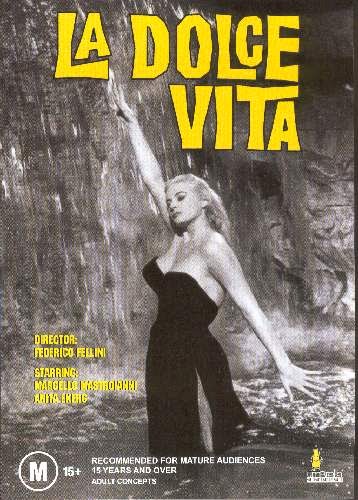
La Dolce Vita [M]


Marcello Rubini was once a fine writer who has now descended to the rank of fine journalist. Seemingly, he has it all: women, sophistication, connections, the best of everything, but the sweet life proves not to be everything as, despite everything he has, he’s not a happy or satisfied person. When a glamorous American actress comes to Rome, she enchants Marcello and the inaccessibility of his desire slowly sends him on a downward spiral. 

Like A Clockwork Orange and The Cook, The Thief, His Wife, and Her Lover, Federico Fellini’s La Dolce Vita takes what is considered glamorous and sophisticated and overcharges it, turning it into something that is almost repulsive. This film is probably most famous for coining the term ‘paparazzi’, which stems from one of its photojournalist characters, so there’s your bit of trivia for the day. But trivia aside, La Dolce Vita still stands as a remarkably cool and glamorous movie that depicts something not very nice, but does it in such a way that makes it look amazing. 

Marcello Rubini was once a fine writer who has now descended to the rank of fine journalist. Seemingly, he has it all: women, sophistication, connections, the best of everything, but the sweet life proves not to be everything as, despite everything he has, he’s not a happy or satisfied person. When a glamorous American actress comes to Rome, she enchants Marcello and the inaccessibility of his desire slowly sends him on a downward spiral. 

Whilst it took me a while to establish what was happening (I think this happens more often than not for Western viewers of foreign movies who aren’t quite as ‘cultured’ as they could be), I cannot deny that there is something incredibly glamorous but at the same time un-glamorous about this movie. The fact that it’s a 60s movie done in black and white instantly says ‘sophistication’, taking us back to the Classical Hollywood Era. There are fast cars, champagne, beautifully clad women with exquisite makeup, irrepressibly cool sunglasses, parties, colourful characters, and the image of the beautiful blonde American actress in the fountain is one that is recognised the world over! Everything about this movie is dripping with glamour and classiness but its story then works against that by chronicling tales of woe and descent in social circles. A line towards the end of the film, “by 1965, there’ll be total depravity” really highlights the messages that this movie sets out to convey: the dehumanising effect of socially sanctioned glamour and sophistication as well as the slow erosion of willpower and ambition that comes as a result of having the finer things accessible to you. There’s an awful lot going on this movie and every event that happens carries some hidden message or dual meaning, which makes it a great film to watch and interpret. 
Starring Marcello Mastroianni, Anita Ekberg, Anouk Aimee, Yvonne Furneaux, Magali Noel, Alain Cuny, Annibale Ninchi, Walter Santesso, Valeria Ciangottini, Riccardo Garrone, Ida Galli, Audrey McDonald, Polidor, Alain Dijon, and Enzo Cerusico, La Dolce Vita is an elegant movie filled with glamour, romance, drama, descent, and comedy. It’s a film that I don’t think I appreciated as fully as I could (because I’m really not all that cultured or cinematically aware no matter how it sounds here), but it’s definitely a film that I was entranced by. Only a handful of movies in history have been both glamorous and un-glamorous and Fellini does it very well.