Showing posts with label Silent. Show all posts

Wednesday, August 20, 2025

Greed

Image credit: Wikipedia
Greed and the pursuit of capital has been a villainous theme in storytelling for centuries, with the hubris of those afflicted delivering satisfying emotional payoff for audiences of all races, ages, and genders. Even though one can absolutely guess where characters are heading in a film entitled Greed, the craftmanship and artistic direction of Erich von Stroheim’s 1924 silent classic still holds shock and cringe value for the modern audience.

The film follows quack dentist, Mac McTeague (Gibson Gowland) who falls in love with an extraction patient, Trina (Zasu Pitts) despite his best friend Marcus (Jean Hersholt) already being sweet on her. As a sign of friendship, Marcus gives Mac his blessing to court Trina, but changes his attitude when, shortly after their marriage, she wins five thousand dollars in a lottery. The sudden fortune starts to put a strain on Mac and Trina’s relationship as Trina hoards her winnings, even when Marcus forces Mac out of business and the couple begins to starve.

An adaptation of the novel McTeague by Frank Norris, Greed is credited as the first film to be shot entirely on location. Showcasing 1920s San Francisco, the film is an epic psychological drama that depicts the poisonous and corrosive nature of addiction. Rather than showing a terrifying descent into madness due to alcohol or narcotics a la Blow or Days of Wine and Roses, Greed explores how the fundamental need for capital can become a cyst that can fester and grow to the point where it destroys even the strongest relationships. Alongside the terrible ends that meet our heroes-turned-villains, we lament the death of the wholesome and sweet tone that the film begins with before Stroheim begins to torment us with disturbing and borderline erotic scenes that include starved and elongated limbs caressing mounds of gold.

The performances are all incredible with Gowland and Pitts both starting the film as likeable and upstanding people and then plummeting into a free-fall of manipulation, gaslighting, drunkenness, and violence.

Image credit: Wikipeda

Considering that the original runtime was over nine hours, then cut down to four and, finally, to two, Stroheim manages to tell a very rich and disturbing story, mainly through his use of mise en scene and reflective metaphors. The shots of Mac’s pet birds that he presents as a wedding gift are particularly powerful in depicting the marital turmoil, beginning the second act as docile and loving creatures before shrieking and fighting some scenes later. We then have the increasing grubbiness of the costumes, set, and even the camera lens as the final scenes in the third act, set in Death Valley, take on a grainier and dustier look – aside from the shots of the bag of gold of course.

A film that claimed notoriety for its behind the scenes story as well as the one it enthrallingly tells on screen, Greed is captivatingly dramatic and disturbing.

Director: Erich von Stroheim, 1924

Cast: Gibson Gowland, Zasu Pitts, Jean Hersholt, Dale Fuller, Tempe Pigott, Sylvia Ashton, Chester Conklin, Franke Hayes & Joan Standing

Sunday, August 3, 2025

Orphans of the Storm

Image credit: Rotten Tomatoes
It’s interesting to consider the vast history of cinema, specifically the fact that we have gone through the advent of sound and colour and computer-generated effects and still there are so many terrible films in the world. As a modern movie-watcher, it tickles me particularly that I can go back and watch a black and white silent movie and still have as good a cinematic experience as if I were watching a contemporary flick.

This morning, I was back into my 1001 project (which now is horrendously outdated, but I’m still going to do it) and watched another epic drama from D. W. Griffith: Orphans of the Storm.

A French aristocrat is forced to abandon her baby born from a commoner and leaves it on the steps of a church with a single note, ‘Her name is Louise. Love her.’ A poor man is about to leave his own daughter, named Henriette, on the same church steps to save her from starvation, but instead brings both babies home and raises them as sisters. After losing their parents to a plague Louise (Dorothy Gish) is left blind and Henriette (Lillian Gish) determines to travel with her to Paris to find a cure. Shortly after arriving the two sisters are separated, Henriette being abducted by a lavish aristocrat and Louise forced to beg for the crooked commoners who ‘charitably’ take her in. As revolution brews in the streets, Henriette tries desperately to escape from her captor and reunite with her sister.

Orphans of the Storm is the last of D. W. Griffiths great, historical melodramas that tells a beautiful story of love in times of turmoil. As extravagant as any of his other works, it's both a visual feast and a dramatic, narrative triumph. Despite being based on a play, Griffith wrote the screen during filming, which obviously gave rise to all sorts of complications. But nevertheless, the film rose to the challenge and even today, remains a masterpiece of stage direction, set and costume design, and dramatic performances.

Sticking to one historical time period unlike Intolerance, the film takes place during the French Revolution giving Griffith ample space to dazzle audiences with lavish and excessive costumes as well as incredible sets that really hammer home the social disconnect between the aristocracy and the working class. Elaborate dresses, and suits, and hats, and wigs put us in mind of the ballroom scene in Labyrinth or an Ultravox music video while you can practically feel the lice crawling over you when you watch the scenes set in the street or impoverished hovels of the commoners.

Image credit: United Artists

The Gish sisters deliver performances that have been praised as the best of their careers, absolutely shadowing the otherwise male-dominated cast.

Filled with drama, romance, action, and suspense, Orphans of the Storm is a classic from a bygone era that still stands up.

Director: D. W. Griffith, 1921

Cast: Lillian Gish, Dorothy Gish, Joseph Schildkraut, Franke Losee, Katherine Emmet, Morgan Wallace, Lucille La Verne, Sheldon Lewis, Frank Puglia, Creighton Hale, Leslie King, Monte Blue, Sidney Herbert, Lee Kohlmar & Marcia Harris

Tuesday, July 22, 2025

Intolerance

Image credit: Amazon
The cinematic masterpiece: what makes it so? We’ve had over a century of cinema and I don’t believe we have even come close to identifying a magic formula that makes a masterpiece. They just are or they become. The ones that later become celebrated thanks to the progression of time and the changing of cultural attitudes are the more interesting ones to consider. Films such as D.W Griffith’s Intolerance.

The film explores tragedy fuelled by intolerance and the struggles of love through the ages over the course of four stories. A selection of events from the life of Jesus, a tale from Babylon in which a king is betrayed by those against his rejection of sectarianism, the story of the St Bartholemew’s Day Massacre of French Protestants, and a modern melodrama in which a young man is wrongly convicted of murder.

While critically hailed as a masterpiece today, thanks to its epic scale and ahead-if-its-time editing, Intolerance is also considered an epic disaster and flop in Hollywood’s history; (ironically) thanks to its epic scale and ahead-if-its-time editing.

Riding high off the success of Birth of a Nation, it’s believed that Griffith made this epic doom-and-gloom saga of tragic love stories as something of a retort to the backlash he received regarding the racial politics in Birth. Indeed, he released a pamphlet entitled ‘The Rise and Fall of Free Speech in America’ to coincide with Intolerance’s release, arguing against film censorship. And it certainly is a film that forces audiences to look at some hard truths about human behaviour. Everything from conspiracy, to betrayal, to incredible violence, to jealousy, to a plethora of prejudices is depicted.

While the audience of the time struggled with the random time-jumping and crosscutting between stories, the modern audience – especially feminist- will cringe at the questionable ‘love’ stories, the rough treatment of women on screen, and the fact that none of the young heroines are given names.

Then there is the sheer size of the thing. The film is famous for having had a couple of million invested in it to make a lavish spectacle: the enormous sets for the Babylon sequences are monumental and very impressive, as well as the elaborate costumes for the both the Babylon story and the French period drama. Add to this a herd of elephants, camels, catapults, and what appears to be a flame-throwing Babylonian tank, it’s a very elaborate visual feast that sadly failed to make back its costs.

Image credit: Amazon

The performances are captivating, if you can keep track of who everyone is, and this is good because both original and contemporary audiences immediately baulk at the thought of sitting down for that long: the film’s runtime is 3 hours.  While the pacing of the first half of the film can stretch and feel doughy, the climactic final act proves to be quite nail-bitingly dramatic and exciting.

There are certainly a number of things about Intolerance that make it a landmark piece of Hollywood history, but I don’t think that the ‘genius’ of D. W. Griffith stands the test of time. Like Metropolis – another piece of extravagant cinema- you need to really psych yourself up to get through this endurance trial of a film.

Director: D. W. Griffith, 1916

Cast: Spottiswoode Aitken, Mary Alden, Frank Bennett, Barney Bernard, Monte Blue, Lucille Browne, Tod Browning, William H. Brown, Edmund Burns, William E. Cassidy, Elmer Clifton, Miriam Cooper, Jack Cosgrove, Josephine Crowell, Dore Davidson, Sam De Grasse, Edward Dillon, Pearl Elmore, Lillian Gish, Ruth Handforth, Robert Harron, Joseph Henabery, Chandler House, Lloyd Ingraham, W. E. Lawrence, Ralph Lewis, Vera Lewis, Elmo Lincoln, Walter Long, Mrs. Arthur Mackley, Tully Marhsall, Mae Marsh, Marguerite Marsh, John P. McCarthy, A.W. McClure, Seena Owen, Alfred Paget, Eugene Pallette, Georgia Pearce, Billy Quirk, Wallace Reid, Allan Sears, George Siegmann, Maxfield Stanley, Carl Stockdale, Madame Sul-Te-Wan, Constance Talmadge, F.A. Turner, W.S. Van Dyke, Guenther von Ritzau, Erich von Stroheim, George Walsh, Eleanor Washington, Margery Wilson, & Tom Wilson

Friday, February 11, 2022

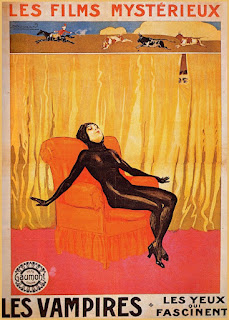
Les Vampires

Image credit: IMDb

It’s most interesting to go back in time and pinpoint where certain trends and fashions began, especially in cinema. With films being churned out faster and faster nowadays thanks to the pandemic and the need for new and original streaming service content, the industry has been put into a somewhat higher gear. But it’s important to remember that even though the world is moving so fast in terms of producing content for us to consume, we can always choose to slow down and go at out own pace: like I did with Louis Feuillade’s fascinating 1915 movie serial, Les Vampires.

This long film, segmented into ten chapters of varying lengths, tells the story of a Parisian crime gang called the Vampires and their eventual takedown by an ambitious journalist (Edouard Mathe) and his comedic sidekick (Marcel Levesque). Kidnapping, murder, and mayhem abound with each chapter telling a different, smaller story that makes up a grand, epic vendetta. 

Les Vampires is an original in so many ways. Definitely not a film you can do in one sitting, its segmented form is perfect for a balanced cinematic experience of intermissions and breathers in which to catch up on what’s just happened. This also gives us time to appreciate just how influential a historical piece it is. It’s the first thriller, the first example of cinematic noir and the surrealist movement, as well as the first moving picture that delivers the exciting detective story (a la Sherlock Holmes) experience. Watching it is a bit like reading Sir Arthur Conan Doyle’s classic tales of the great detective, with the audience being privy to the tricks and traps of the villains while the hero is not. 

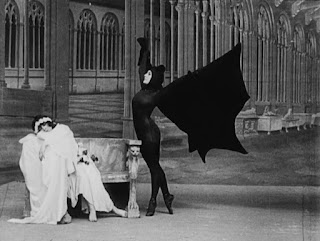
As a representation of society and culture, Les Vampires is mightily clever, as it makes a point to show that good and evil is not always clear and distinct. While the Vampires themselves are merciless and manipulative with brutal means of executing their plans, they are not without their own system of law and government and indeed, at many points during the film the heroes plot and scheme in much the same fashion. This bleeding of the boundaries between good and evil is what makes the film so fascinating, more so considering the fact that the villains name themselves after the most celebrated of evil monsters. 

Image credit: IMDb

We then have the superb visual aspect of the film. While the footage itself is grainy and definitely dated, it does not take away from the fact that there are so many exciting visual treats, mostly to do with the more action-y sequences and sinister stealth plots. Considering this was made in 1915, the set designs are incredible with elaborate trap doors, tricks walls, and sliding panels that would put the castle of Otranto to shame! At one point an entire canon comes sliding out of a wall to fire at a nearby cabaret! Then there are some of the greatest chase sequences I’ve ever seen. The Vampires main mode of travel is shimmying up and down drainpipes, scaling walls, and darting from rooftop to rooftop, which makes for very exciting chases when the good guys get on their tail. We’ve got people being thrown from rooftops into moving cars, people spinning down Cirque du Soleil style to make quick getaways, and enough many nooks and hidey-holes to turn Parisian apartments into Swiss cheese. 

Les Vampires is a stretch, admittedly to sit down and commit to, but one that it worth the investment, especially if you’re as interesting in film history as I am.

Director: Louis Feuillade, 1915

Cast: Edouard Mathe, Musidora, Marcel Levesque, Jean Ayme, Fernand Herrmann & Stacia Napierkowska

Wednesday, February 17, 2021

The Birth of a Nation

Image credit: IMDb

It’s often enlightening and sometimes disturbing to watch a film from over a hundred years ago and realise that some things never change, and that aspects of modern culture continue to be influenced by it or follow in its shadow. For my afternoon it was disturbing, as I sat down to a film that is critically acclaimed for its innovations in cinema and socially disdained for its subject matter. Yep, I sat down and watched The Birth of a Nation.

Told in two parts the film follows two American families: the Northern Stonemans and the Southern Camerons. Part one follows them through the Civil War, beginning with the introduction of slavery to America and then jumping right in to the fighting, before ending on the assassination of Lincoln. Part two then follows the families through the Reconstruction era and the rise of the Ku Klux Klan.

Writer/director/producer D. W. Griffith makes a point of claiming his indifference to the racism of the subject material, the film being an adaptation of Thomas Dixon’s play The Clansman: An Historical Romance of the Ku Klux Klan, but that did not stop the film being absolutely reviled upon its release for its horrendous and disturbing depictions of the Ku Klux Klan as heroic saviours. It’s undoubtedly one of the most racist and shocking films ever made and yet it’s still studied to this very day. Why?

Here’s why. It was the first real cinematic epic, a film so artistically compelling that audiences would stay put for the entire three hours despite the shocking content. It was the birth of modern camera techniques with Griffith introducing dramatic close-ups and tracking shots amongst others as well as the birth of cinematic editing with the introduction of crosscutting, parallel action sequences, and more. A lot of modern cinema owes its very skeleton, consciously or not, to this film and while the artist did not agree with the message of his medium, he still put everything into making undeniable art. 

Image credit: Britannica

It just goes to show that the ‘don’t shoot the artists’ mentality in cinema has been around for over a century and debates are still surrounding this piece. 

The Birth of a Nation is probably one of the rarest films ever, being both morally condemned and artistically celebrated. However it’s a film for people who love film; I most certainly would not recommend it to those who enjoy watching moves, but aren’t so invested in the inner workings of the medium. 

Director: D. W. Griffith, 1915

Cast: Lillian Gish, Mae Marsh, Henry B. Walthall, Miriam Cooper, Mary Alden, Ralph Lewis, George Siegmann, Walter Long, Robert Harron, Wallace Reid, Joseph Henabery, Elmer Clifton, Josephine Crowell, Spottiswoode Aitken, & George Beranger


Tuesday, September 29, 2020

The Thief of Bagdad

Image credit: IMDb
We know that fantasy is timeless; wondrous narratives filled with magic, drama, and heroic quests transcend generations and will continue to so do until all mediums for expressing them are extinguished. This fact has been proven time and time again with various films, however I am still amazed just how much the love for such tales and their own longevity can keep something afloat when the tides of time wash everything else away. 

This afternoon, my film of choice was The Thief of Bagdad, thus the stimulant for my current awe and train of thought. 


The film tells the story of Ahmed, a common thief living in Bagdad who one night sneaks into the palace to plunder it. But once inside his love for treasure is surpassed when he beholds the beautiful princess and he decides to steal her instead. Pretending to be a prince, Ahmed wins the princess’ heart, but his true identity is quickly revealed and he barely escapes with his life. To save her from a forced marriage, Ahmed travels through great lands of wonder and peril to find a rare treasure that will prove his love and worth.


The exotic and romantically erotic setting of Arabia remains tried and true to this day. The gorgeous and extravagant set pieces for this film form a world entirely their own. Despite the grainy, black and white filter and the overblown acting, The Thief of Bagdad still proves to be a cinematic giant capable of grabbing an audience of thousands in one hand squeezing the collective breath out of it.


Without a doubt, the triumphant awe factor of the film is its incredible set: six and a half acres and the biggest set in Hollywood history. Each set from the Caliph’s palace to the underwater cavern of the sirens is absolutely jaw dropping, made all the more incredible by the achievements in costume design. Silks, satins, sequins, and jewels adorn even the commonest thieves in this movie, making the central Bagdad a realm of fantasy. 


Image credit: TV Tropes
But amidst its rich and exotic aesthetic, the film serves a succinct and powerful narrative of a person’s ability to change. A moral story lies at the centre of the swashbuckling action and political drama and the character arc of Ahmed is both predictable and satisfying. 


While the film itself is quite outdated, and many of the ‘special effects’ had not held up all that well, there is still an awful lot of enjoyment to be taken from this 1920s classic and one can easily see why it has remained in cinema’s classics canon. 


Director: Raoul Walsh, 1924

Cast: Douglas Fairbanks, Snitz Edwards, Charles Belcher, Julanne Johnston, Sojin, Anna May Wong, Brandon Hurst, Tote Du Crow, & Noble Johnson


Tuesday, September 8, 2020

Stachka (Strike)

Image credit: Amazon.co.uk
In a depressing start to a gloomy Wednesday morning, I just finished watching a silent masterpiece that brutally highlights the despicable and unfeeling side of humanity. Sergei Eisenstein’s Stachka (or Strike) might be a bit dated, but it really hammers home the idea that humans as a species have a diabolical dark side that tends to win out every time, especially in times of high stress. 

Strike depicts an uprising in a Russian factory, as a series of mistreatments mixed with the authorities’ greed and dishonesty goad the workers towards rebellion. Told in six parts, the film begins with a series of ripples, which then grow into the dramatic events of the following chapters, escalating to strike, starvation, counter rebellion, and finally a massacre. 

Intended to mark the beginning of a series of works about the rise of Marxist-Lenin rule, Strike never got its follow-ups thanks to Bolshevik censorship. However, the film does work as a stand-alone feature (indeed it was Eisenstein’s first and paved the way for other such masterpieces as The Battleship Potempkin [1925] and October [1927]). 

 Eisenstein explores various cinematic tricks and motifs that greatly exacerbate the central drama and carnage of the political messages, the most poignant being in the final chapter where depictions of the massacre are intercut with scenes of cows being slain in a slaughterhouse. This graphically horrific and metaphoric trick is enough to break one’s positive spirit and cause nightmares, even a seasoned mover-goer. 

Image credit: Silver in a Haystack

But of course, this is the point. Eisenstein’s fascination and appreciation of the film medium as a communication, cultural and political means of expression really comes across with this film and while his treatment of his audience is to emotionally hijack them and then continuously punch them in the face until their nose cave and their cheekbones splinter, it nevertheless gets the job done effectively. 

Director: Sergei M. Eisenstein, 1924 Cast: Grigori Aleksandrov, Aleksandr Antonov, Yudif Glizer, Mikhail Gomorov, I. Ivanov, Ivan Klyukvin, Anatoll Kuznetsov, Vladimir Uralsky, Vera Yanukova, & Boris Yurtsev

Wednesday, August 5, 2020

Our Hospitality

Image credit: Amazon.com
Continuing on with the ‘1001 countdown’, this afternoon’s film was a Buster Keaton classic, Our Hospitality.

A delightfully witty and hilariously suspenseful satire, the film begins with a dramatic prologue that establishes an age-old feud between two families that transcends generations. Twenty years later, the protagonist, Willie McKay (Buster Keaton) who has been innocently raised in New York returns to his family home, only to run right into the family that wants to spill his blood: the Canfields. Having fallen in love with Canfield’s daughter whom he met on the train, Willie endeavours to become a permanent resident in the Canfield house, as Southern hospitality dictates that they can’t shoot him as long as he’s a guest under their roof.

Delightfully taking the piss out of Southern manners, Our Hospitality proves to be another cinematic triumph for Keaton. Blended between uproariously funny sequences including an unbelievable train ride, Willie’s escape in drag, and his heroically saving his beloved from plunging over a waterfall, and glorious suspense, the film sits in that wonderful place between drama and comedy. One could even go as far as to call this an epic love story… or at least a farce of one.

Image credit: Pinterest
Keaton, as ever, delights and entrances with a performance that is understated during the quieter scenes and hilariously active during the exciting ones. Having also directed the film, alongside John G. Blystone, he uses everything at his disposal including his perfect understanding and grasp on camera framing, character, mise en scene, and period. His sense of timing is impeccable, which (coupled with his wit) is what makes the film both so funny and so beautiful.

Our Hospitality is an absolute gem that stands the test of time. The satire, sight gags, and perfectly timed comedic sequences continue to delight and enchant almost a century later!

Director, John G. Blystone & Buster Keaton, 1923

Cast: Buster Keaton, Joe Roberts, Ralph Bushman, Craig Ward, Monte Collins, Joe Keaton, Kitty Bradbury, Natalie Talmadge, & Buster Keaton Jr.

Wednesday, July 29, 2020

Foolish Wives

Image credit: Google Sites
Now that I’ve got my drive back for ‘project 1001’, it’s time to make a valiant effort to keep it that way, hence this afternoon I hunkered down with what is critically considered as Erich von Stroheim’s masterwork.

Foolish Wives stars Stroheim himself as the charismatic scam artist Count Karamzin who, along with the help of his ‘cousins’ Princesses Olga and Vera Petchnikoff, works to seduce the neglected wife an American diplomat recently arrived in Monte Carlo, stealing a small fortune in the process.

The 1920’s were a very experimental time for cinema, not merely with the tricks and magics that could be achieved with the camera and special effects, but with visual narrative as well.

After Foolish Wives, Stroheim was celebrated as cinema’s first great ironist, as the film turns all conventional film narratives cleanly upside down and inside out. The antihero and his costars are by far the more entertaining and engaging characters, a stark comparison to the heroes/victims: the boring, bland Americans. Glamorising Monte Carlo, tenderly referred to in the film as ‘Hell’s Paradise’, Stroheim enraptures his audience with mesmerising scenes of raucous gaiety, gambling, and scheming, without a moral or cautionary message appearing until the final shot. As such, your emotional attachments, bar perhaps one, are with the ‘villains’ throughout. This cynical feeling towards the neglected heroine is even mirrored in the judgmental inflection of the film’s title, which –ironically- is also the name of the book she reads in-film!

Image credit: Tumblr
But the film is not all garish fun and cynical breaking of hearts. A darker underline follows the narrative, beautifully expressed through the multiple ‘love stories’ that Karamzin stars in. No woman is safe regardless of wealth, nationality, or even mental competency, and the film’s drama, which gloriously rears its head in the third act, is a wonderfully poignant and satisfying narrative turn. Without spoiling anything, the final twenty minutes of the film are the most compelling, poetic, and narratively satisfying minutes you’ll spend staring at a screen!

Foolish Wives was truly a step forward for narrative in cinema, it could even be argued to be the silver screen’s first black comedy (loosely), and it’s definitely a film I would recommend to fellow cinephiles!

Director: Erich von Stroheim, 1923

Cast: Erich von Stroheim, Rudolph Christians, Miss DuPont, Maude George, Mae Busch, Dale Fuller, Al Edmudsen, Cesare gravina, Malvina Polo, Louis K. Webb, Mrs. Kent, C. J. Allen, & Edward Reinach

Sunday, July 26, 2020

Haxan

Image credit: mastercontol -Tumblr
I must apologise to any of my readers who have actually been following my quest to review all ‘1001 films you must see before you die’ (very outdated now). My resolve to complete this quest has been erratic and flimsy –to be kind- and I have not reviewed a canonical classic in donkey’s years!
But today I got back in the saddle.
A lull in a rainy afternoon inspired me to do a quick Youtube search for an early 1920s film that was not over 3-hours long and unearthed a disturbing gem in cinematic history: Haxan.

This ‘documentary’ is from Danish filmmaker Benjamin Christensen and is an exploration into the belief in the devil and witchcraft during Medieval times and the Renaissance.

If my lectures in uni were this engaging and unforgettable, I surely would have gotten all HDs! Christensen’s film is a glorious (and often terrifying) piece of cinema that defies genre as it’s part academic exploration into an earlier time –the early scenes do remind one of being in a university lecture theatre- and part horror movie.

The film is a montage of stills, models, pictures, and dramatic reenactments, which come with their own breathtaking photographical tricks and visual delights. Indeed it’s a piece that really explores all possible avenues of theatre and the artistic industry – it’s a celebration really- that still manages to disturb and awe a modern audience. Amidst the pointer outlining various characters in a medieval painting, the film boasts a mechanical set, photographic layering to depict spectres, and impressive achievement in makeup and costume design during the more dramatic parts that are reenactments of the Sabbath and a medieval witch trial.
Christensen’s attention to detail and the power of mise-en-scene is spectacular and can undoubtedly be held as the inspiration for many a modern horror movie including The Exorcist or anything by Tobe Hooper.

Johns Hopkins Unversity
But my review of Haxan is not all praise. While it still manages to engage a modern audience, there are definite cracks and marks of out-datedness, especially during he film's exploration into the modern day, in particular, mental health and its relations to medieval witchcraft. 2020 viewers, coming from a world where there is more awareness of mental illness than ever, might find some of the filmmaker's opinions on the subject disturbing or offensive. But we must remember that this movie reflects a different time and social attitude, so this flame can't be held against it for too long. 
Whilst its stubborn lack of genre makes it initially hard to warm to, perseverance is rewarded and Haxan sits within cinematic history as a true piece of experimental masterwork.

Director: Benjamin Christensen, 1922

Cast: Elisabeth Christensen, Astrid Holm, Karen Winther, Maren Pedersen, Ella La Cour, Emmy Schonfeld, Kate Fabian, Oscar Stribolt, Clara Pontoppidan, Else Vermehren, Alice O’Fredericks, Johannes Andersen, Elith Plo, Aage Hertel & Ib Schonberg

Tuesday, May 7, 2019

Nanook of the North

Image credit: Wikipedia
There are multiple points of debate and controversy within cinema, but one that definitely takes the cake has been the genre of the documentary, and by extension, the subgenre of the biopic. At this moment in time, the debates surrounding the genre and subgenre are louder than ever, as the cinema is currently being flooded with entertaining, yet arguably strongly fictionalised biopics: Bohemian Rhapsody, Rocket Man, and Tolkien.

The birth of the documentary and the idea of true stories being immortalised on screen truly began with the birth of cinema and the Lumiere brother’s footage of a train. However, canonically the title of the ‘father of the documentary’ and therefore, instigator of the whole reality vs. cinema doco-debate has been bestowed on Robert J. Flaherty and his stunning documentary feature, Nanook of the North.

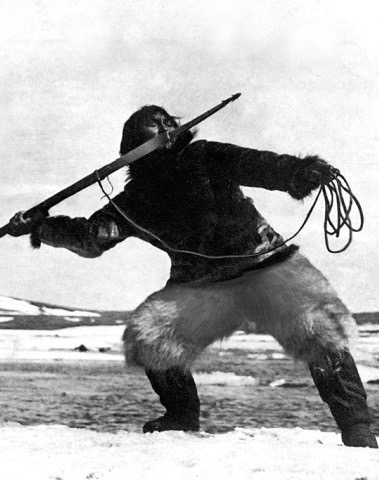
The film follows a celebrated Inuit hunter, Nanook (the Bear), and his family as they travel across the stark and brutal Arctic landscapes in an ongoing search for food. Delightfully, the film chronicles their day-to-day activities, which range from the mundane (igloo building), to the funny (Nyla, Nanook’s wife, chewing his boots to soften them), to the dangerous (walrus hunting).

A series of simple and sequential vignettes that detail the life of Nanook and his family over the course of a few weeks, much of the film’s significance within cinematic history comes from its ability to divide its audiences in a great debate that has transcended generations, as well as its gorgeous blend of reality and art. Many contemporary audiences are critical of the movie because a large portion of it does seem to be staged cinema, as well as the knowledge that Flaherty –after losing all his original footage in 1916- based much of the film on what he could remember originally shooting, which resulted in crafted, rather than natural, scenes of Nanook doing activities he commonly did, some he hadn’t done in a while, and some that he never did at all.

Image credit: Entertainment
However, defenders of the film commend it on its brutally truthful depiction of a very harsh and unforgiving environment as well as an inspiring story of enduring human determination, resourcefulness, and strength. Indeed the final scene, which depicts Nanook and his family taking shelter from an insane snowstorm, is one of the most chilling (pardon the pun) moments in movie history. Sadly, this scene gained more potency after the film’s release when it was revealed that Nanook and his family had perished in a storm not long after completing the film.

Regardless of its divided audience as to whether everything in it is fact or fiction, Nanook of the North still stands as a touching and rather breathtaking film, both in its content and as an art form.

Director: Robert J. Flaherty

Cast: Nanook, Nyla, Cunayou, Allee,  and Allegoo

Sunday, May 5, 2019

La Souriante Madame Beudet (The Smiling Madame Beudet)

Image credit: Wikipedia
While characters such as Captain Marvel and Wonder Woman might be outshining the menfolk in the cinema today, the whole ‘sisters are doing it for themselves’ thing is nothing new. Indeed one of the earliest celebrated works of feminist cinema and slams against the patriarchy goes back as far as 1922, with Germaine Dulac’s La Souriante Madame Beudet (The Smiling Madame Beudet).

The film tells the story of a despondent and unfulfilled provincial housewife (Germaine Dermoz) whose only escape from her monotonous existence is daydreaming. Her husband, a man with a warped sense of humour is constantly playing a prank on her in which he holds an unloaded revolver to his head and threatens to shoot. When her husband begins to intrude upon her daydreams, she decides to take the fun away from his joke by putting bullets in the gun.

The Smiling Madame Beudet proves to be an important piece in movie history for a number of reasons. First, it is one of the earliest recorded works of feminist cinema. The film is an exploration into patriarchal oppression both culturally and within the home. This is highlighted by the heroine’s lack of control in all of her daily ventures, including the straightening of the house. One particularly poignant scene, which is both humorous and heartbreaking, is the constant battle of the flower vase in which Madame Beudet will move it elegantly to the side of the table, only to have Monsieur Beudet shift it back to the centre. A simple, but powerful metaphor for the amount of control exercised by the patriarchy, it is these delicate motifs and scenes that give the film its power.

Image credit: YouTube
Alongside being one of the earliest examples of feminist cinema, the film is also celebrated as a work of experimental cinema, with Madame Beudet’s daydream sequences using an array of clever photographic tricks and filmic twists to convey the fantasy of the scenes as well as the drama, hostility, and melancholy behind them.

The film’s short duration mixed with the uncanny amount of suspense it manages to build within that time –which my or may not find satisfactory release- makes The Smiling Madame Beudet a most moving piece of cinema, even if it does leave one feeling a tad dispirited at the end.

Director: Germaine Dulac, 1922

Cast: Germaine Dermoz, Alexandre Arquilliere, Jean d’Yd, and Madeleine Guitty

Thursday, April 25, 2019

Korkarlen (The Phantom Carriage)

Image credit: Amazon UK
One of my all-time favourite things about going back in time with cinema is when you find those films that spawned so many recognisable and iconic scenes. It’s a truly weird and delightful feeling when you watch a scene in a really old movie and it reminds you of a scene in a film that was made decades later and that part of your brain that remembers and stores scenes and images lights and begins whirring like mad. This afternoon I watched a particularly good one of these movies: Korkarlen (The Phantom Carriage).

Rather reminiscent of Dickens’ classic ghost story, Korkarlen takes place on New Years’ Eve at the bedside of a dying Salvation Army sister (Astrid Holm). Her dying wish is to see the man whom she loves turn over a new leaf. Outside in the cold the man of her prayers, David Holm, (Victor Sjostrom) is drinking away the remains of the year when he gets into a tussle with his companions and dies. Death’s carriage arrives to take his soul, but the driver –a former sinner and friend of David’s- prolongs the engagement by showing David’s ghost all the pain and misery he has caused in the hope that there might still be time to save his soul.

Historically, The Phantom Carriage is a cinematic masterpiece for a number of reasons. Not only did it cement the fame of Swedish silent cinema throughout the 1920s, it is probably one of the most widely sampled and quoted films within modern cinema –especially in films that depict the spirit world.
It might not be the first, but it is definitely the most celebrated ghost movie in silent cinema, with the scene of the soul rising from the deceased body and then staring back down at it, being one of the most widely recognisable sequences in modern movies. Made in a simple, but incredibly time-consuming and meticulous way with series of double exposures, the film was the first time audiences got to see a three-dimensional ghost world on screen and it’s truly haunting.

The eerie tale of disease, decay, and spiritual corruption is highlighted further by the supernatural element as well as the film’s (at the time) modern narrative method of telling the story through flashbacks and even flashbacks within flashbacks. All this results in an intricate and complex tale of society in decline, which would depress even the dead, but is uplifted by its resounding message of hope and the opportunity of turning over a new leaf that the New Year brings. It is wonderfully metaphoric while at the same being completely sincere and the drama and horror of the central stories of woe is superbly brought out by the mesmerising performances of the cast.

Image credit: IMDb
Sjostrom in particular, is a captivating protagonist, beginning the film as this cackling and hateful, disease-ridden human who, in true Scrooge fashion, gets sense finally knocked into him through a series of scares and forced re-livings of his own past perils. Getting all the best scenes in the movie including looking down at his own corpse and breaking down a locked door with an axe a la Jack Nicholson, (“Heeere’s Johnny!”) it’s a true testament to the power of visual storytelling and performance that this hateful character can make us cry along with him in the end, and seriously Sjostrom is remarkable!

The Phantom Carriage influenced the works of Ingmar Bergman, Stanley Kubrick, and practically every other director who ever did a transparent ghost movie, and even all these years later it still stands up as a truly moving, impressive, and iconic film.

Director: Victor Sjostrom, 1921

Cast: Victor Sjostrom, Hilda Borgstrom, Tore Svennberg, Astrid Holm, Concordia Selander, Lisa Lundholm, Tor Weijden, Einar Axelsson, Olof As, Nils Ahren, Simon Lindstrand, Nils Elffors, Algot Gunnarsson, Hildur Lithman, and John Ekman

Wednesday, April 24, 2019

Within Our Gates

Image credit: IMDb
Perhaps now, more than ever, there is a heftier demand for stigmas and taboos surrounding people who were not born old, white, males to be abolished and for all industries to come to the realisation that the talents within those industries, whether they come from a woman, an African-American, an Asian, or a transgender person, are just as great and important as the white man’s.
Green Book may have snagged the Oscar this year, but its triumph is hardly a celebration of colour, race, and the changing times (some would argue it’s exactly the opposite). The ridiculousness of the whole conservative white power within the Academy becomes even more frustrating and stupid when you consider that African-American cinema has been around since the 1920s!
This brings me to my film of choice this afternoon: Within Our Gates.

Written, produced, and directed by Oscar Micheaux, the film tells a moving and tragic story of a black teacher (Evelyn Preer) who travels north to raise money for her rural school in the south that educates black children. Alongside this central story are several others including a severed romance, a murder, and the hunt for an underworld crime boss.

Within Our Gates is s significant piece of cinema. Not only is it a brutal depiction of racial prejudice and oppression in 1920s America (both in the north and south) it is the earliest surviving feature from an African-American director. Micheaux proves that art can be achieved by anyone regardless of race, gender, or religion with this film that both violently and succinctly reflects the times. What is most impressive about Within Our Gates is that it’s a brutal and searing depiction of clashing cultural attitudes as well as open racism whilst at the same time being a stirring melodrama and fusion of popular movie genres that offer something for a wide audience. It’s a romance, it’s a tragedy, it’s even a little bit of a thriller at one point and this fantastic fusion of genres makes for a really fulfilling movie experience within the space of just over an hour.

Image credit: Movies Silently
Dramatic and mesmerising performances keep eyes on screens, along with the haunting orchestral soundtrack, and the captions (which double as the credits) are particularly nice, taking a leaf from Huckleberry Finn and being written in a unique phonetic dialect of the Deep South.
Considering that the film was lost for seventy years –it was rediscovered at the Filmoteca Espanola in Madrid and restored shortly after- none of its cultural significance or relevance has faded and it might be time to resurrect a few of these old classics.

Director: Oscar Micheaux, 1920

Cast: Evelyn Preer, Flo Clements, James D. Ruffin, Jack Chenault, William Smith, Charles D. Lucas, Bernice Ladd, Mrs. Evelyn, William Stark, Mattie Edwards, Ralph Johnson, E.G. Tatum, Grant Edwards, Grant Gorman, and Leigh Whipper

Monday, May 21, 2018

Seven Chances

Image credit: DVD Planet Store
Buster Keaton’s penchant for sight gags and nail-biting anticipation are what made his brand of comedy so successful and continues to keep it thriving amongst modern moviegoers. Thanks to the wonders of the Internet and YouTube, such gems as Sherlock Jr. and Seven Chances are accessible to the wider audience and Keaton’s dazzling blend of slapstick comedy and heartfelt love stories continues to endure, hallelujah!

Seven Chances tells the story of Jimmie Shannon, the junior partner of a law firm that gets tricked into a substantial amount of debt. A ray of hope shines out when Jimmie inherits seven million dollars from a deceased relative, however he can only inherit it on the proviso that he’s married before 7pm on his 27th birthday. Only learning this on the day of the deadline, and accidently blowing his chances with his one true love, Jimmie has only a matter of hours to find a bride before nightfall.

Image credit: Pinterest
Teeming with memorable sights gags, slapstick, and tongue-in-cheek humour, Seven Chances mixes a classic race-against-time story with something of an epic romance. A thriving rom-com of its time, the film addresses a number of social issues including gender differences, race, religion, and age barriers. While some of the humour is a tad trying and outdated, Keaton’s classic blend between action, romance, and comedy keeps the film fresh and memorable.
Amongst a number of classic stunts and scenes, none is so enjoyable as Jimmie’s climactic chase through town pursued by a horde of angry women. Truly, hell hath no fury like a woman scorned and the image of Keaton racing for his life a la Indiana Jones is one that will stay with you forever. Even Mother Nature gets in on the act!

The weirdness and wackiness of Seven Chances, everything from its random obsession with the number 7 to its nonsensical gags about fixed identities, is something of a treat amongst the blockbuster franchises that dominate our screens.

Director: Buster Keaton, 1925
Cast: Buster Keaton, T. Roy Barnes, Snitz Edwards, Ruth Dwyer, Frances Raymond, Erwin Connelly, and Jules Cowles

Tuesday, May 15, 2018

Sherlock Jr.

Image credit: Rotten Tomatoes
Before John Cleese, before Mel Brooks, before the Marx Brothers, and before Charlie Chaplin there was Buster Keaton: an undeniable sweetheart of slapstick! Many filmmakers today continue to pay homage to the great cinephile whose films were not just about the laughter, but filled with rich social commentaries and explorations into that temperamental state between fiction and reality. Perhaps his best –albeit his shortest- film to wade these satisfying waters is Sherlock Jr.

Sitting at a mere 44 minutes long, Sherlock Jr. tells the story of a young projectionist (Buster Keaton) who is simultaneously studying to be a detective. His questionable mystery-solving skills are put to the test when he is accused of stealing from his girlfriend’s father and he sets out to find the real thief: a rival suitor (Ward Cane).

Beginning as a rather sweet, yet lamenting love story in that romance has somehow been lost and replaced with social awkwardness and materialism, the film quickly transcends into the realms of crisp and glorious comedy with a number of sight gags and breathtaking stunts –all dangerous and done by Keaton himself. Scenes such as Keaton attempting to shadow his suspect truly stand the test of time and will definitely stay with me for a long time to come!

While the central story is undeniably simple, the film is beefed up and made richer by its exploration into the voyeuristic allure of literature and cinema. During one of the most magnificent dream sequences in movie history, which features a lot of clever optical tricks and illusions quite modern for the time, the protagonist leaves his failure of a persona in reality and steps into the world of film becoming a character his real-self could only dream of: Sherlock Jr. the world’s second best detective. As the film-within-the-film plays out a choreographed and more exciting version of the protagonist’s own story, the film becomes a reflection on the nature of art and a celebration of its powers of enlightenment, compensation, escapism and fulfillment. It even leaves you with a fabulous little sexual joke at the end, which could still stand up on modern screens!

Image credit: Pinterest
More than this, Sherlock Jr. is a sweet and satisfying romp that might be dealing with some complex themes, but does not let that stand in the way of a good time! There are a number of memorable stunts and sight gags that comedy fans all over the world will enjoy including Keaton's turning a car crash into a romantic boat ride, his death-defying bicycle chase, and his hilarious movie clip montage. Seriously, hit up YouTube right now and watch this movie!

Director: Buster Keaton, 1924

Cast: Buster Keaton, Kathryn McGuire, Joe Keaton, Erwin Connelly, and Ward Cane