Showing posts with label Classics. Show all posts

Friday, February 11, 2022

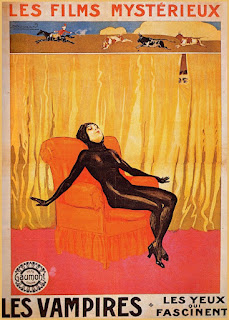
Les Vampires

Image credit: IMDb

It’s most interesting to go back in time and pinpoint where certain trends and fashions began, especially in cinema. With films being churned out faster and faster nowadays thanks to the pandemic and the need for new and original streaming service content, the industry has been put into a somewhat higher gear. But it’s important to remember that even though the world is moving so fast in terms of producing content for us to consume, we can always choose to slow down and go at out own pace: like I did with Louis Feuillade’s fascinating 1915 movie serial, Les Vampires.

This long film, segmented into ten chapters of varying lengths, tells the story of a Parisian crime gang called the Vampires and their eventual takedown by an ambitious journalist (Edouard Mathe) and his comedic sidekick (Marcel Levesque). Kidnapping, murder, and mayhem abound with each chapter telling a different, smaller story that makes up a grand, epic vendetta. 

Les Vampires is an original in so many ways. Definitely not a film you can do in one sitting, its segmented form is perfect for a balanced cinematic experience of intermissions and breathers in which to catch up on what’s just happened. This also gives us time to appreciate just how influential a historical piece it is. It’s the first thriller, the first example of cinematic noir and the surrealist movement, as well as the first moving picture that delivers the exciting detective story (a la Sherlock Holmes) experience. Watching it is a bit like reading Sir Arthur Conan Doyle’s classic tales of the great detective, with the audience being privy to the tricks and traps of the villains while the hero is not. 

As a representation of society and culture, Les Vampires is mightily clever, as it makes a point to show that good and evil is not always clear and distinct. While the Vampires themselves are merciless and manipulative with brutal means of executing their plans, they are not without their own system of law and government and indeed, at many points during the film the heroes plot and scheme in much the same fashion. This bleeding of the boundaries between good and evil is what makes the film so fascinating, more so considering the fact that the villains name themselves after the most celebrated of evil monsters. 
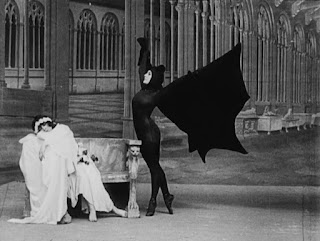
Image credit: IMDb

We then have the superb visual aspect of the film. While the footage itself is grainy and definitely dated, it does not take away from the fact that there are so many exciting visual treats, mostly to do with the more action-y sequences and sinister stealth plots. Considering this was made in 1915, the set designs are incredible with elaborate trap doors, tricks walls, and sliding panels that would put the castle of Otranto to shame! At one point an entire canon comes sliding out of a wall to fire at a nearby cabaret! Then there are some of the greatest chase sequences I’ve ever seen. The Vampires main mode of travel is shimmying up and down drainpipes, scaling walls, and darting from rooftop to rooftop, which makes for very exciting chases when the good guys get on their tail. We’ve got people being thrown from rooftops into moving cars, people spinning down Cirque du Soleil style to make quick getaways, and enough many nooks and hidey-holes to turn Parisian apartments into Swiss cheese. 

Les Vampires is a stretch, admittedly to sit down and commit to, but one that it worth the investment, especially if you’re as interesting in film history as I am.

Director: Louis Feuillade, 1915

Cast: Edouard Mathe, Musidora, Marcel Levesque, Jean Ayme, Fernand Herrmann & Stacia Napierkowska

Wednesday, August 5, 2020

Our Hospitality

Image credit: Amazon.com
Continuing on with the ‘1001 countdown’, this afternoon’s film was a Buster Keaton classic, Our Hospitality.

A delightfully witty and hilariously suspenseful satire, the film begins with a dramatic prologue that establishes an age-old feud between two families that transcends generations. Twenty years later, the protagonist, Willie McKay (Buster Keaton) who has been innocently raised in New York returns to his family home, only to run right into the family that wants to spill his blood: the Canfields. Having fallen in love with Canfield’s daughter whom he met on the train, Willie endeavours to become a permanent resident in the Canfield house, as Southern hospitality dictates that they can’t shoot him as long as he’s a guest under their roof.

Delightfully taking the piss out of Southern manners, Our Hospitality proves to be another cinematic triumph for Keaton. Blended between uproariously funny sequences including an unbelievable train ride, Willie’s escape in drag, and his heroically saving his beloved from plunging over a waterfall, and glorious suspense, the film sits in that wonderful place between drama and comedy. One could even go as far as to call this an epic love story… or at least a farce of one.

Image credit: Pinterest
Keaton, as ever, delights and entrances with a performance that is understated during the quieter scenes and hilariously active during the exciting ones. Having also directed the film, alongside John G. Blystone, he uses everything at his disposal including his perfect understanding and grasp on camera framing, character, mise en scene, and period. His sense of timing is impeccable, which (coupled with his wit) is what makes the film both so funny and so beautiful.

Our Hospitality is an absolute gem that stands the test of time. The satire, sight gags, and perfectly timed comedic sequences continue to delight and enchant almost a century later!

Director, John G. Blystone & Buster Keaton, 1923

Cast: Buster Keaton, Joe Roberts, Ralph Bushman, Craig Ward, Monte Collins, Joe Keaton, Kitty Bradbury, Natalie Talmadge, & Buster Keaton Jr.

Wednesday, July 29, 2020

Foolish Wives

Image credit: Google Sites
Now that I’ve got my drive back for ‘project 1001’, it’s time to make a valiant effort to keep it that way, hence this afternoon I hunkered down with what is critically considered as Erich von Stroheim’s masterwork.

Foolish Wives stars Stroheim himself as the charismatic scam artist Count Karamzin who, along with the help of his ‘cousins’ Princesses Olga and Vera Petchnikoff, works to seduce the neglected wife an American diplomat recently arrived in Monte Carlo, stealing a small fortune in the process.

The 1920’s were a very experimental time for cinema, not merely with the tricks and magics that could be achieved with the camera and special effects, but with visual narrative as well.

After Foolish Wives, Stroheim was celebrated as cinema’s first great ironist, as the film turns all conventional film narratives cleanly upside down and inside out. The antihero and his costars are by far the more entertaining and engaging characters, a stark comparison to the heroes/victims: the boring, bland Americans. Glamorising Monte Carlo, tenderly referred to in the film as ‘Hell’s Paradise’, Stroheim enraptures his audience with mesmerising scenes of raucous gaiety, gambling, and scheming, without a moral or cautionary message appearing until the final shot. As such, your emotional attachments, bar perhaps one, are with the ‘villains’ throughout. This cynical feeling towards the neglected heroine is even mirrored in the judgmental inflection of the film’s title, which –ironically- is also the name of the book she reads in-film!

Image credit: Tumblr
But the film is not all garish fun and cynical breaking of hearts. A darker underline follows the narrative, beautifully expressed through the multiple ‘love stories’ that Karamzin stars in. No woman is safe regardless of wealth, nationality, or even mental competency, and the film’s drama, which gloriously rears its head in the third act, is a wonderfully poignant and satisfying narrative turn. Without spoiling anything, the final twenty minutes of the film are the most compelling, poetic, and narratively satisfying minutes you’ll spend staring at a screen!

Foolish Wives was truly a step forward for narrative in cinema, it could even be argued to be the silver screen’s first black comedy (loosely), and it’s definitely a film I would recommend to fellow cinephiles!

Director: Erich von Stroheim, 1923

Cast: Erich von Stroheim, Rudolph Christians, Miss DuPont, Maude George, Mae Busch, Dale Fuller, Al Edmudsen, Cesare gravina, Malvina Polo, Louis K. Webb, Mrs. Kent, C. J. Allen, & Edward Reinach

Sunday, May 5, 2019

La Souriante Madame Beudet (The Smiling Madame Beudet)

Image credit: Wikipedia
While characters such as Captain Marvel and Wonder Woman might be outshining the menfolk in the cinema today, the whole ‘sisters are doing it for themselves’ thing is nothing new. Indeed one of the earliest celebrated works of feminist cinema and slams against the patriarchy goes back as far as 1922, with Germaine Dulac’s La Souriante Madame Beudet (The Smiling Madame Beudet).

The film tells the story of a despondent and unfulfilled provincial housewife (Germaine Dermoz) whose only escape from her monotonous existence is daydreaming. Her husband, a man with a warped sense of humour is constantly playing a prank on her in which he holds an unloaded revolver to his head and threatens to shoot. When her husband begins to intrude upon her daydreams, she decides to take the fun away from his joke by putting bullets in the gun.

The Smiling Madame Beudet proves to be an important piece in movie history for a number of reasons. First, it is one of the earliest recorded works of feminist cinema. The film is an exploration into patriarchal oppression both culturally and within the home. This is highlighted by the heroine’s lack of control in all of her daily ventures, including the straightening of the house. One particularly poignant scene, which is both humorous and heartbreaking, is the constant battle of the flower vase in which Madame Beudet will move it elegantly to the side of the table, only to have Monsieur Beudet shift it back to the centre. A simple, but powerful metaphor for the amount of control exercised by the patriarchy, it is these delicate motifs and scenes that give the film its power.

Image credit: YouTube
Alongside being one of the earliest examples of feminist cinema, the film is also celebrated as a work of experimental cinema, with Madame Beudet’s daydream sequences using an array of clever photographic tricks and filmic twists to convey the fantasy of the scenes as well as the drama, hostility, and melancholy behind them.

The film’s short duration mixed with the uncanny amount of suspense it manages to build within that time –which my or may not find satisfactory release- makes The Smiling Madame Beudet a most moving piece of cinema, even if it does leave one feeling a tad dispirited at the end.

Director: Germaine Dulac, 1922

Cast: Germaine Dermoz, Alexandre Arquilliere, Jean d’Yd, and Madeleine Guitty

Thursday, April 25, 2019

Korkarlen (The Phantom Carriage)

Image credit: Amazon UK
One of my all-time favourite things about going back in time with cinema is when you find those films that spawned so many recognisable and iconic scenes. It’s a truly weird and delightful feeling when you watch a scene in a really old movie and it reminds you of a scene in a film that was made decades later and that part of your brain that remembers and stores scenes and images lights and begins whirring like mad. This afternoon I watched a particularly good one of these movies: Korkarlen (The Phantom Carriage).

Rather reminiscent of Dickens’ classic ghost story, Korkarlen takes place on New Years’ Eve at the bedside of a dying Salvation Army sister (Astrid Holm). Her dying wish is to see the man whom she loves turn over a new leaf. Outside in the cold the man of her prayers, David Holm, (Victor Sjostrom) is drinking away the remains of the year when he gets into a tussle with his companions and dies. Death’s carriage arrives to take his soul, but the driver –a former sinner and friend of David’s- prolongs the engagement by showing David’s ghost all the pain and misery he has caused in the hope that there might still be time to save his soul.

Historically, The Phantom Carriage is a cinematic masterpiece for a number of reasons. Not only did it cement the fame of Swedish silent cinema throughout the 1920s, it is probably one of the most widely sampled and quoted films within modern cinema –especially in films that depict the spirit world.
It might not be the first, but it is definitely the most celebrated ghost movie in silent cinema, with the scene of the soul rising from the deceased body and then staring back down at it, being one of the most widely recognisable sequences in modern movies. Made in a simple, but incredibly time-consuming and meticulous way with series of double exposures, the film was the first time audiences got to see a three-dimensional ghost world on screen and it’s truly haunting.

The eerie tale of disease, decay, and spiritual corruption is highlighted further by the supernatural element as well as the film’s (at the time) modern narrative method of telling the story through flashbacks and even flashbacks within flashbacks. All this results in an intricate and complex tale of society in decline, which would depress even the dead, but is uplifted by its resounding message of hope and the opportunity of turning over a new leaf that the New Year brings. It is wonderfully metaphoric while at the same being completely sincere and the drama and horror of the central stories of woe is superbly brought out by the mesmerising performances of the cast.

Image credit: IMDb
Sjostrom in particular, is a captivating protagonist, beginning the film as this cackling and hateful, disease-ridden human who, in true Scrooge fashion, gets sense finally knocked into him through a series of scares and forced re-livings of his own past perils. Getting all the best scenes in the movie including looking down at his own corpse and breaking down a locked door with an axe a la Jack Nicholson, (“Heeere’s Johnny!”) it’s a true testament to the power of visual storytelling and performance that this hateful character can make us cry along with him in the end, and seriously Sjostrom is remarkable!

The Phantom Carriage influenced the works of Ingmar Bergman, Stanley Kubrick, and practically every other director who ever did a transparent ghost movie, and even all these years later it still stands up as a truly moving, impressive, and iconic film.

Director: Victor Sjostrom, 1921

Cast: Victor Sjostrom, Hilda Borgstrom, Tore Svennberg, Astrid Holm, Concordia Selander, Lisa Lundholm, Tor Weijden, Einar Axelsson, Olof As, Nils Ahren, Simon Lindstrand, Nils Elffors, Algot Gunnarsson, Hildur Lithman, and John Ekman

Wednesday, April 24, 2019

Within Our Gates

Image credit: IMDb
Perhaps now, more than ever, there is a heftier demand for stigmas and taboos surrounding people who were not born old, white, males to be abolished and for all industries to come to the realisation that the talents within those industries, whether they come from a woman, an African-American, an Asian, or a transgender person, are just as great and important as the white man’s.
Green Book may have snagged the Oscar this year, but its triumph is hardly a celebration of colour, race, and the changing times (some would argue it’s exactly the opposite). The ridiculousness of the whole conservative white power within the Academy becomes even more frustrating and stupid when you consider that African-American cinema has been around since the 1920s!
This brings me to my film of choice this afternoon: Within Our Gates.

Written, produced, and directed by Oscar Micheaux, the film tells a moving and tragic story of a black teacher (Evelyn Preer) who travels north to raise money for her rural school in the south that educates black children. Alongside this central story are several others including a severed romance, a murder, and the hunt for an underworld crime boss.

Within Our Gates is s significant piece of cinema. Not only is it a brutal depiction of racial prejudice and oppression in 1920s America (both in the north and south) it is the earliest surviving feature from an African-American director. Micheaux proves that art can be achieved by anyone regardless of race, gender, or religion with this film that both violently and succinctly reflects the times. What is most impressive about Within Our Gates is that it’s a brutal and searing depiction of clashing cultural attitudes as well as open racism whilst at the same time being a stirring melodrama and fusion of popular movie genres that offer something for a wide audience. It’s a romance, it’s a tragedy, it’s even a little bit of a thriller at one point and this fantastic fusion of genres makes for a really fulfilling movie experience within the space of just over an hour.

Image credit: Movies Silently
Dramatic and mesmerising performances keep eyes on screens, along with the haunting orchestral soundtrack, and the captions (which double as the credits) are particularly nice, taking a leaf from Huckleberry Finn and being written in a unique phonetic dialect of the Deep South.
Considering that the film was lost for seventy years –it was rediscovered at the Filmoteca Espanola in Madrid and restored shortly after- none of its cultural significance or relevance has faded and it might be time to resurrect a few of these old classics.

Director: Oscar Micheaux, 1920

Cast: Evelyn Preer, Flo Clements, James D. Ruffin, Jack Chenault, William Smith, Charles D. Lucas, Bernice Ladd, Mrs. Evelyn, William Stark, Mattie Edwards, Ralph Johnson, E.G. Tatum, Grant Edwards, Grant Gorman, and Leigh Whipper

Sunday, April 21, 2019

Beat the Devil

Image credit: Wikipedia
While I claim to be a ‘humble’ cinephile, there is a certain level of pomp that edges its way into my opinions; honestly that’s just basic human nature: we all muddle our facts and opinions and put too much clout behind them. But when it comes to movies, my passion does surpass my attempts to be humble. I don’t wonder, but do believe that audiences who boycott black and white films are incorrect.
Some of the quirkiest and cleverest films that I have ever seen have been in black and white. Despite its seemingly primitiveness, black and white films are the more horrifying, romantic, and thrilling features to grace screens. If you want proof, just compare Hitchcock’s Psycho to Gus Van Sant’s and tell me I’m wrong.
Ranting aside, I got onto this train of thought after watching a truly classic and witty little black and white comedy this afternoon: Beat the Devil.

Beginning with a shot of four crooks in irons and a Bogart voice-over, the film flashes back and tells the story of Billy Dannreuther (Humphrey Bogart), a formerly-wealthy American fallen on hard times and is reluctantly working for four international crooks who are trying to steal uranium-rich land in British East Africa. Set to travel to Africa by boat, the group are to sail with a strangely inquisitive British married couple and hilarious misdemeanours ensue in the shape of a bizarre love triangle, clumsy backstabs, and a series of miscommunications that land everyone in hot water.

Beat the Devil is a movie that flew relatively under the radar. Produced by Bogart and directed by John Huston (who wrote the screenplay with Truman Capote) the film is a fun genetic splice of comedy and noir (think Bob Hope comedy meets Bogart noir thriller). While the humour of the story is very witty and tongue-in-cheek rather than screwball, the sheer strangeness of the cast as well as the screenplay’s genre fluidity is what makes it so damned enjoyable.

Image credit: Film Comment Magazine
Bogart is classic Bogart playing against a motley group of strange and whimsical characters including a fascist, militant hitman, a poncy English gentlemen, a fast-talking lady with an over-stimulated imagination, an exotic and brooding dark beauty, and the most upstanding and unintimidating crime leader you could ever imagine.
Being an independent film and an international coproduction is certainly what gave Beat the Devil its creative freedom and loosey-goosey feel, which is experienced by everyone, actors and audiences alike. It’s a truly weird, but highly entertaining movie.

Director: John Huston, 1953

Cast: Humphrey Bogart, Gina Lollobridgida, Jennifer Jones, Robert Morely, Peter Lorre, Edward Underdown, Ivor Barnard, Marco Tulli, Bernard Lee, Mario Perrone, Guilio Donnini, Saro Urzi, Aldo Silvani, and Juan de Landa

Tuesday, May 15, 2018

Sherlock Jr.

Image credit: Rotten Tomatoes
Before John Cleese, before Mel Brooks, before the Marx Brothers, and before Charlie Chaplin there was Buster Keaton: an undeniable sweetheart of slapstick! Many filmmakers today continue to pay homage to the great cinephile whose films were not just about the laughter, but filled with rich social commentaries and explorations into that temperamental state between fiction and reality. Perhaps his best –albeit his shortest- film to wade these satisfying waters is Sherlock Jr.

Sitting at a mere 44 minutes long, Sherlock Jr. tells the story of a young projectionist (Buster Keaton) who is simultaneously studying to be a detective. His questionable mystery-solving skills are put to the test when he is accused of stealing from his girlfriend’s father and he sets out to find the real thief: a rival suitor (Ward Cane).

Beginning as a rather sweet, yet lamenting love story in that romance has somehow been lost and replaced with social awkwardness and materialism, the film quickly transcends into the realms of crisp and glorious comedy with a number of sight gags and breathtaking stunts –all dangerous and done by Keaton himself. Scenes such as Keaton attempting to shadow his suspect truly stand the test of time and will definitely stay with me for a long time to come!

While the central story is undeniably simple, the film is beefed up and made richer by its exploration into the voyeuristic allure of literature and cinema. During one of the most magnificent dream sequences in movie history, which features a lot of clever optical tricks and illusions quite modern for the time, the protagonist leaves his failure of a persona in reality and steps into the world of film becoming a character his real-self could only dream of: Sherlock Jr. the world’s second best detective. As the film-within-the-film plays out a choreographed and more exciting version of the protagonist’s own story, the film becomes a reflection on the nature of art and a celebration of its powers of enlightenment, compensation, escapism and fulfillment. It even leaves you with a fabulous little sexual joke at the end, which could still stand up on modern screens!

Image credit: Pinterest
More than this, Sherlock Jr. is a sweet and satisfying romp that might be dealing with some complex themes, but does not let that stand in the way of a good time! There are a number of memorable stunts and sight gags that comedy fans all over the world will enjoy including Keaton's turning a car crash into a romantic boat ride, his death-defying bicycle chase, and his hilarious movie clip montage. Seriously, hit up YouTube right now and watch this movie!

Director: Buster Keaton, 1924

Cast: Buster Keaton, Kathryn McGuire, Joe Keaton, Erwin Connelly, and Ward Cane

Wednesday, May 9, 2018

Way Down East

Image credit: Movie Posters
There have been some pretty epic and tragic love stories in movie history - Jack and Rose, Christian and Satine, Wesley and Buttercup- and I have just come across another couple that needs to be added to this grand company: David and Anna!

Way Down East tells the tragic story of beautiful and innocent country girl Anna Moore (Lillian Gish) who goes to live with some rich relatives for a time. During her stay she becomes the infatuation of one Lennox Sanderson (Lowell Sherman) who tricks her out of her virtue with a sham marriage only to abandon her as soon as she falls pregnant. Homeless and alone Anna seeks work at a farmhouse where she and her employer’s son (Richard Barthelmess) fall in love. But her shameful past catches up with her when she discovers that her neighbour is none other than Lennox Sanderson!

An epic melodrama adapted from the novel and the stage play, W. D Griffiths’ Way Down East is an uncelebrated epic love story that rivals any of those mentioned above. Beginning as something of a Cinderella story it takes a rather serious turn as the central themes of religious conservatism, polygamy, and prejudices between social classes come into the mix completely weighing down the heroine to the point of practically destroying her soul. One’s heart completely goes out to Anna whose tragic story goes from bad to worse as she suffers through terrible loss, betrayal, and shame. Lillian Gish’s performance is stunning piquing all sorts of emotional responses like swooning, crying, and moaning in hopelessness and frustration.

Image credit: IMDb
Amidst the betrayal, secrets, and climactic third act that would give Jack and Rose a run for their money, there is also a number of screwball romantic comedies that pepper the film and bring a healthy balance of relief and laughter. The professor’s bumbling courtship of Kate is simply gorgeous and the cringe-inducing relationship between Seth and Martha is almost laughably unbearable to watch.

During a time when the tastes of the public were shifting away from Griffiths’ signature melodramas and artistic films the success of this movie was surprising. It just goes to show that a beautiful story, strong performances, and a well-crafted editing job can bring anything back into fashion and it can never be said that Griffiths didn’t deliver just that!


Starring: Lillian Gish, Richard Bathelmess, Mrs. David Landau, Lowell Sherman, Burr McIntosh, Kate Bruce, Vivia Ogden, Porter Strong, Mary Hay, Creighton Hale, and Emily Fitzroy

Wednesday, April 18, 2018

Broken Blossoms

Image credit: Kino Lorber
Most modern audiences don’t hold for black and white movies –let alone the silent films of the 1900s that now seem so grainy and hard to watch. While I can understand where these tastes and intolerances stem from, I’m here to say that it’s ok to be wrong. 
Silent movies can be just as humorous, dramatic, or suspenseful as any modern romance, thriller, or comedy. In fact some even hold up better with age. A cinematic exploration into the silent era is more than a mere peek at an age gone by: watching such films as those of D. W. Griffith or Buster Keaton give us a great sense of the fundamental building blocks of cinema that shape the ones we see today. Not to mention most of the stories are so beautifully timeless. One such movie is Broken Blossoms.

The film tells the tragic story of a Chinaman (Richard Barthelmess) that travels to London to teach the barbarous Anglo-Saxons the gentle ways of Buddha. Sadly his dreams are never recognised and he lives as a lonely shopkeeper. His singular joy is his hidden love of a young woman (Lillian Gish) that occasionally marvels at his shop window. One night –after escaping from her abusive father- the girl collapses in his doorway and a forbidden love blossoms between them as he nurses her back to the health. Meanwhile, her father gets wind of her whereabouts and sees fit to exercise some parental rights.

The forbidden romance is a tale as timeless as the hills, but what makes it so incredibly beautiful in Broken Blossoms is the way the film is put together. W. D. Griffiths had a famous reputation for film studies and this movie really shows why. The cinematography is simple but breathtaking with every inventive trick available from powdered makeup to special lighting to oil smeared over the camera lens. Such beautiful moments as close-ups of the love-struck hero through an unfocused lens or the rose tints that characterize the bedroom his prepares for the girl still inspire the heart to flutter and tears to spring to the eyes making it a film that is an experience rather than just something to watch.

Image credit: AllPosters
While a visually gorgeous film it’s also beautifully poetic. The titular ‘broken blossoms’ can refer to anything: the broken dreams of the Chinaman, Lucy’s broken spirit, or even the sizeable fracture between the two cultures. While the sets are limited to the squalid house of Lucy and her father and the oriental opium dens and shop interior there is a wonderful balance between the two worlds the film travels through as well as this gorgeous and continual shift between the mundane and brutal and the ethereal.
This is a truly beautiful film!


Starring: Lillian Gish, Richard Barthelmess, Donald Crisp, Arthur Howard, Edward Pell Sr., George Beranger, and Norman Selby

Monday, March 5, 2018

Angel On My Shoulder

Image credit: Wikipedia
It’s always interesting to go back and watch older examples of a popular genre: comedies, for example. Comedy as a genre has come a long way, fracturing into a multitude of subgenres that continue to develop and morph with the changing of the times. While some continue to be just as strong as they ever were –like the buddy comedy or romantic comedy- there are some that have sunken into a form of obscurity –the evangelical comedy for example.

With a title like Angel On My Shoulder you would immediately think of a romantic comedy, but this quirky little movie actually tells an entertaining story of redemption, even after death. When harsh gangster Eddie Kagel (Paul Muni) gets popped by his own partner, he goes straight to Hell and it seems that an eternity of shoveling coal and keeping Hellfire going is all that awaits him. But when the Devil (Claude Rains) discovers Eddie’s resemblance to a do-gooder judge he’s trying to condemn, Eddie is offered the chance for revenge. Brought back to Earth in the body of his doppelganger, Eddie soon discovers there’s a good man in him and while his own soul may be condemned he can still save others’ –including the judge’s beautiful fiancé (Anne Baxter).

The closest thing to an evangelical comedy that the 20th century  - and 21st for that matter- has to offer is that remake of Bedazzled starring Elizabeth Hurley and Brendan Fraser. It’s obvious this subgenre has become irrelevant in these modern times, yet it’s interesting to watch a film such as Angel On My Shoulder and find that it still leaves an impression. The story is fresh, original, and clever: a really lovely moral story combined with unsavory characters. Much of the movie’s comedy comes as a fountain of irony as the Devil’s plans are continuously bungled by his pawn, Eddie. The sweeter side of the story comes from Eddie’s being in the Judge’s body and experiencing glimpses of a good life. The tale is a perfect path for character development, which is done beautifully, and by the end of the film one feels warm and quite content.

Image credit: Classic Cinema Images
Dancing hand-in-hand with the screenplay is a wonderful cast –all of whom bring a lot of breadth to their characters. There are no flat, 2-dimensional characters to be found and the entire cast did so well in conveying the inner workings of their roles. Paul Muni begins as the classic gangster archetype, providing comedy in his character’s clashing with the Judge’s lifestyle, and finally becoming a person at peace. The transformation is subtle, but it’s really sweet. Claude Rains as the Devil proves to be a wonderful villain because you can’t actually hate him. His depiction of the Prince of Darkness is one of a man constantly at war and trying his very hardest to prove himself, yet somehow always being thwarted. Rains delivers a gracious and sweet-natured performance that casts Satan in as fine a light as any decent, hard-working man.

It’s a shame there’s no room in today’s society for films like Angel On My Shoulder, but I am thankful that there are movies like this out there that can be rediscovered and revisited and still provide their audiences with a laugh and a warm feeling by the end.

Starring: Paul Muni, Anne Baxter, Claude Rains, Onslow Stevens, George Cleveland, Erskine Sanford, Marion Martin, James Flavin, and Hardie Albright 

Sunday, February 25, 2018

The Phantom From 10,000 Leagues

Image credit: Amazon
What would modern horror movies be without the terrible B-grade flicks that pepper the genre’s history? As with anything we need to take some time to appreciate the terrible so that we might really admire the great. With that thought in mind, I draw attention to The Phantom From 10,000 Leagues

This independently made monster movie tells the story of a mad scramble for a uranium deposit on the ocean floor and a marine scientist’s experiment gone wrong. After a fisherman’s corpse covered in radiation burns washes up on the beach a marine biologist and federal detective rally together to uncover the mystery. The theory is that a uranium deposit on the ocean floor is the culprit, but that changes when the biologist discovers a terrifying creature in the depths. Suspicion then turns to a local marine scientist and his mysterious research.

It may not be the flashiest or stylish monster move ever made –in all honesty it’s actually pretty terrible- but this movie really does make you appreciate other monster movies, especially older ones you watch as a modern viewer. This film in all its non-budget, B-grade splendor can actually give you a cute little history lesson. Celebrated cinema nowadays does not necessarily stem from the classic and sophisticated monster movies of the ‘30s, ‘40’s, and ‘50s. Case in point, there was a moment in this movie that strongly reminded me of Jaws. The lesson is that you can take something bad and improve upon it: make it bigger, faster, better. And watching a film like this hammers home that point.

Image credit: Titans Terror Toys
As a film this is pretty terrible. Everything from the uninspired performances to the papier-mâché monster that manages to overturn a boat simply by floating to the surface and booping it with its head is ridiculous.
I’ll give them snaps for trying with the story though. To compensate for the lack of money to spend on makeup and special effects the writers actually tried to concoct a story with some serious intrigue and came up with a fun –though probably wholly unrealistic- science-fiction war weapon plotline that opened the doors for a wide cast of characters and multiple storylines. Snaps.

If you can see the beauty in bad monster movies as well as good, then watch this. If not, you can live a full and happy life without it.


Starring Kent Taylor, Cathy Downs, Michael Whalen, Helene Stanton, Phillip Pine, Rodney Bell, Vivi Janis, Michael Garth, and Pierce Lyden

Tuesday, December 26, 2017

Mr. Skeffington

Image credit: Wikipedia
The lust after youth and the perks that follow is probably one of the most common yet powerful villains in film and literature. Vanity claimed the life of Dorian Gray, drove a queen to murder her daughter, and turned life into a tragically hollow and meaningless show in the latest film that I have watched: Mr. Skeffington.

The film begins telling the sad story of Fanny and Trippy Trellis who find themselves at the mercy of one Job Skeffington (Claude Rains), the man whom Trippy has embezzled thousands of dollars. Practically penniless, the beautiful and vain Fanny (Bette Davis) employs her looks to hook Mr. Skeffington whom she then marries. But the marriage is cordial and loveless with Fanny pouring all her affection into her looks and capturing multiple admirers. But while she is transfixed by the beauty in the mirror the world around her disintegrates with war, disease, and the ravaging effects of time, rapidly leaving her with no time to appreciate everything else she once had.

While the film begins as a charming and almost comedic film about two siblings trying to get out of trouble, it quickly morphs into something else entirely as more dramatic and tragic events unfold. Despite the fact that the central characters are not very agreeable people, one definitely feels remorse and overwhelming sympathy for them by the end. It seems that everyone gets put through the ringer, making this drama not one that should be entered into too lightly.

Image credit: TV Tropes
No doubt the emotions stirred up by this film must be credited to the glorious performances of Bette Davis and Claude Rains who are no Tracey and Hepburn, but somehow end up having one of the most tragic love stories. Despite all the unpleasantness that happens throughout the film, the two radiate back towards each other and there is a most heartbreaking reconciliation scene at the end. 
Bette Davis is beautiful, charming, and cordial with this very slight conniving edge that keeps you captivated because you’re dying to find out if she’s really a cold user of men or if there’s a deeper level to her vanity. 
Claude Rains is a wonderfully stoic puppy dog that you can’t help but be intrigued by. As one personality is charming and exuberant, the other is stoic and reserved and the two play off each other rather wonderfully, despite the lack of any conventional romance.

Like many higher budget films of the 1940s, Mr Skeffington is also a feast for the eyes. It could be because all these movies were done in black and white that the sets, costume, and makeup design had to be extravagant to compensate. Regardless, like the gothic charm of Sunset Boulevard or the eternal good taste of Laura, this film takes place in a world of lavishness, great size, and glamour. The costumes are remarkable and the house where the central drama takes place is simply beautiful -though foreboding and frightening towards the end-  giving audiences other things to appreciate if the story is not entirely their thing.

Mr. Skeffington is a film reminiscent of so many others: there are certain things about it that puts us in mind of Jezebel, Snow White, Dorian Gray and so on, but what’s particularly lovely about it is its tragic and original tale of true love, which is definitely one for the ages.


Starring: Bette Davis, Claude Rains, Walter Abel, George Coulouris, Richard Waring, Marjorie Riordan, Robert Shayne, John Alexander, Jerome Cowan, Dorothy Peterson, Peter Whitney, and Bill Kennedy 
Year: 1944 
Rating: PG